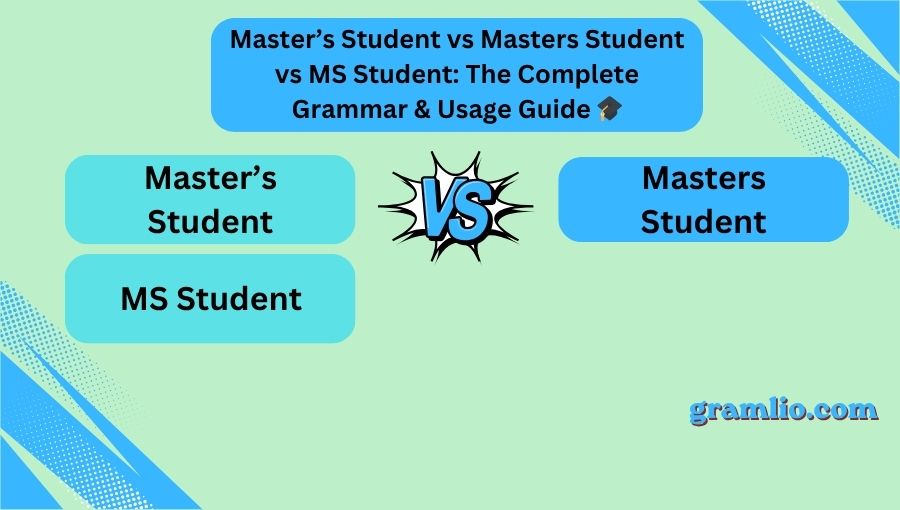
Master’s Student vs Masters Student vs MS Student: The Complete Grammar & Usage Guide 🎓
Have you ever stared at a sentence and wondered whether to write Master’s Student vs Masters Student vs MS Student? 🤔 You are not alone. This grammar question confuses students, graduate applicants, professors, and even experienced writers because these terms look almost identical at first glance. A tiny apostrophe or abbreviation may seem unimportant, but in academic and professional writing, small details can completely change correctness and meaning.
Many people assume all three forms mean the same thing and can be used interchangeably. Others believe “masters student” is simply a shorter version of “master’s student.” That misunderstanding creates confusion in emails, resumes, university applications, LinkedIn profiles, and academic papers. In reality, one form follows standard grammar rules, one is commonly used as an abbreviation, and one is often considered incorrect in formal English.
In this guide, you’ll learn the difference between each term, understand the grammar behind them, see practical examples, and discover easy tricks to remember the correct usage every time. 🎓
This version places the exact focus keyword in the opening paragraph while keeping readability and SEO strength intact.
Quick Answer Section: Master’s Student vs Masters Student vs MS Student

A master’s student is the correct formal term used in academic English to describe someone pursuing a master’s degree. The apostrophe shows possession, meaning the student belongs to a master’s program.
“Masters student” (without an apostrophe) is grammatically incorrect in formal writing, though it is sometimes seen informally or in casual usage. “MS student” is an abbreviation meaning “Master of Science student,” commonly used in universities and resumes.
👉 In short:
- Master’s student = Correct formal grammar
- Masters student = Incorrect (missing apostrophe)
- MS student = Acceptable abbreviation (context-specific)
Understanding the Basics: Master’s Student vs Masters Student vs MS Student
To understand this fully, we need to break the terms down grammatically and contextually.
What “Master’s Student” Means
The correct term “master’s student” uses a possessive form. It refers to a student enrolled in a master’s degree program.
- “Master’s” = possessive form of “master’s degree”
- “Student” = the person studying in that program
Example:
- She is a master’s student at Harvard University.
What “Masters Student” Means
“Masters student” is a common mistake. It removes the apostrophe, which breaks grammatical rules in formal English.
Example (Incorrect):
- He is a masters student in biology.
Why it’s wrong:
It incorrectly treats “masters” as a plural noun instead of a possessive adjective.
What “MS Student” Means
“MS student” stands for Master of Science student. It is widely used in:
- University applications
- Transcripts
- Resumes
- Informal academic communication
Example:
- She is an MS student in Data Science.
Comparison Table
| Form | Type | Meaning | Example | Correct/Incorrect |
|---|---|---|---|---|
| Master’s student | Possessive noun | Student pursuing a master’s degree | She is a master’s student in psychology. | ✅ Correct |
| Masters student | Incorrect form | Missing apostrophe usage | He is a masters student. | ❌ Incorrect |
| MS student | Abbreviation | Master of Science student | She is an MS student in engineering. | ✅ Acceptable |
Correct Meanings & Uses
1. Master’s Student (Formal Academic Writing)
This is the most grammatically correct and widely accepted form.
Sentence Example:
- I am a master’s student specializing in international relations.
Breakdown:
- “Master’s” modifies “degree”
- “Student” is the subject
Test Tip 🧠:
If you can mentally expand it to “master’s degree student,” the apostrophe form is correct.
2. MS Student (Scientific & Technical Contexts)
This abbreviation is very common in STEM fields.
Example:
- He is an MS student in Artificial Intelligence.
When to use:
- University applications
- Lab introductions
- Email signatures
- Resume summaries
Test Tip 🧪:
If your degree is officially titled “Master of Science,” MS is appropriate.
3. Masters Student (Common Error Form)
This form appears often due to typing habits or autocorrect errors.
Example of incorrect usage:
- ❌ She is a masters student in economics.
Why it happens:
- People assume “masters” is plural like “bachelors”
- Lack of grammar awareness
- Informal texting habits
Case Study Section 📚
Real-Life Scenario: University Email
Incorrect version:
Dear Professor, I am a masters student in your data analytics class.
Correct version:
Dear Professor, I am a master’s student in your data analytics class.
Why it matters:
In academic communication, grammar accuracy affects credibility. Professors and institutions expect formal correctness, especially in written communication.
Grammar Rules Explanation
The correct usage comes from English possessive noun rules.
Rule:
When a noun indicates possession or association, an apostrophe is used.
- Master’s degree = degree belonging to a master’s level program
- Master’s student = student belonging to that program
Authority Reference:
Dictionaries like Merriam-Webster confirm that possessive forms like “master’s degree” require an apostrophe because they describe a type of academic qualification.
Common Mistakes
Why people confuse these terms
- Fast typing ⌨️ leads to missing punctuation
- Autocorrect may remove apostrophes
- Informal writing habits
- Misunderstanding of possessive grammar
Similar Grammar Confusions Table
| Incorrect Form | Correct Form | Reason |
|---|---|---|
| its a good day | it’s a good day | contraction missing apostrophe |
| your welcome | you’re welcome | wrong homophone |
| masters student | master’s student | missing possessive apostrophe |
| bachelors degree | bachelor’s degree | missing apostrophe |
Usage in Different Contexts
1. Everyday Conversation 🗣️
- “I’m a master’s student right now.”
2. Professional Writing 💼
- “She is currently a master’s student at the University of Chicago.”
3. Creative Writing ✍️
- “The master’s student spent nights in the library chasing answers.”
4. Social Media/Texting 📱
- “Just started my MS program! #gradschool”
Why It Matters (Important)
Correct grammar is more than formality—it builds credibility.
- Enhances professional image
- Improves academic writing quality
- Prevents miscommunication
- Reflects attention to detail
“Small grammar details create big impressions in professional writing.”
Even a missing apostrophe can subtly affect how your writing is perceived in academic or corporate environments.
Special Exception
There are no official exceptions in grammar rules for “master’s student.”
However:
- “MS student” is widely accepted in STEM fields
- Some institutions prefer “graduate student” instead
Always check institutional style guides when in doubt.
Quick Recap Checklist
| Question | If Yes → Use |
|---|---|
| Referring to formal degree student? | master’s student |
| Using abbreviation in STEM context? | MS student |
| Writing informal or incorrect form? | masters student ❌ |
Practice Examples:
- She is a ___ student in biology. → master’s
- He is an ___ student in engineering. → MS
- He is a ___ student (incorrect form). → avoid
FAQs
1. Is “masters student” grammatically correct?
No, it is incorrect in formal English because it lacks the apostrophe required for possessive form.
2. What is the correct spelling: master’s or masters?
The correct spelling is master’s student, with an apostrophe.
3. Can I use MS student in formal writing?
Yes, especially in technical, academic, or STEM-related contexts.
4. Why is there an apostrophe in master’s student?
Because it shows possession—referring to a student of a master’s program.
5. Is it okay to use “masters student” in speech?
Yes, spoken English often drops strict grammar rules, but writing should remain correct.
6. What is more professional: MS student or master’s student?
“Master’s student” is more formal; “MS student” is acceptable in technical fields.
Conclusion
Understanding the difference between master’s student vs masters student vs MS student is essential for anyone writing about education or academic qualifications. The correct formal usage is master’s student, which follows proper possessive grammar rules. The incorrect form “masters student” is a common mistake caused by missing apostrophes or informal writing habits. Meanwhile, MS student is a widely accepted abbreviation used in technical and scientific contexts.
Using the correct form improves clarity, professionalism, and credibility in academic and professional communication. Whether you are writing a resume, email, or academic paper, choosing the right term ensures your message is accurate and polished.
Grammar may seem small, but details like apostrophes make a big difference in how your writing is perceived. Master this rule, and your academic English instantly becomes stronger and more professional. 🎓
Also Read This: Most Important vs Most Importantly

I’m Julian Crestwood, and I work at Gramlio. I’m an expert in grammar and help learners write confidently with easy and practical guidance.