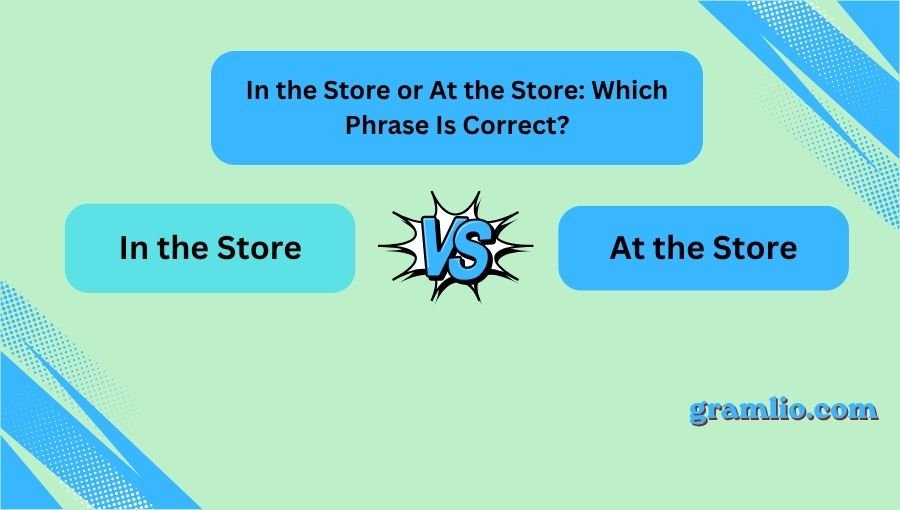
In the Store or At the Store: Which Phrase Is Correct?
The phrase “in the store or at the store” often causes confusion for English learners and native speakers alike. Have you ever stopped while writing a text message, email, or social media post and wondered which one is correct? 🤔 You are not alone. Many people hesitate when choosing between these two common expressions because they seem very similar.
The confusion happens because both phrases can refer to someone being at a store, and in many situations they appear interchangeable. However, they are not always used in exactly the same way. The choice depends on whether you are emphasizing a person’s general location or their physical position inside the building.
Understanding the difference between in the store or at the store can make your communication clearer, more natural, and more precise. Whether you are speaking with friends, writing professionally, or creating content online, using the correct phrase helps you sound confident and accurate.
In this guide, you will learn the meanings, grammar rules, examples, common mistakes, practical applications, and expert tips for mastering the difference between in the store and at the store.
Quick Answer: In the Store or At the Store

Both “in the store” and “at the store” are correct, but they have slightly different meanings.
- At the store refers to someone’s general location or destination.
- In the store specifically means someone is physically inside the store building.
For example:
✅ “I’m at the store right now.”
✅ “I’m in the store looking for milk.”
The first sentence focuses on location, while the second emphasizes being inside the store.
Understanding the Basics: In the Store or At the Store
The main difference comes from the prepositions in and at.
- At usually refers to a general place or point.
- In refers to being inside an enclosed space.
Comparison Table
| Form | Type | Meaning | Example | Correct/Incorrect |
|---|---|---|---|---|
| At the store | Prepositional phrase | Located at the store generally | I am at the store. | ✅ Correct |
| In the store | Prepositional phrase | Inside the store building | I am in the store. | ✅ Correct |
| At the store buying groceries | General location | Shopping at a store | She is at the store now. | ✅ Correct |
| In the store parking lot | Incorrect use | Parking lot is outside | He is in the store parking lot. | ❌ Usually Incorrect |
| At the store entrance | Specific location point | Near entrance | We met at the store entrance. | ✅ Correct |
Correct Meanings and Uses
Using “At the Store”
The phrase at the store focuses on location rather than physical position inside the building.
Examples
- I am at the store.
- She stopped at the store after work.
- We are at the store buying snacks.
Sentence Breakdown
I am at the store.
- Subject: I
- Verb: am
- Prepositional phrase: at the store
The speaker’s exact position is not important. They are simply located there.
Test Tip ✅
If you can replace the phrase with “at that location”, then at the store is probably the best choice.
Using “In the Store”
The phrase in the store highlights being physically inside the building.
Examples
- I am in the store near the bakery section.
- There are many customers in the store today.
- She is in the store comparing prices.
Sentence Breakdown
She is in the store comparing prices.
The sentence specifically tells us she is inside the building.
Test Tip ✅
If you can replace the phrase with inside the building, use in the store.
When Both Are Acceptable
Sometimes either phrase works.
Example
“I’m at the store.”
“I’m in the store.”
Both are correct.
The difference is subtle:
- At the store = location.
- In the store = inside the building.
Case Study Section
Real-Life Text Conversation
Alex: Where are you?
Jordan: I’m at the store.
Alex: Can you grab some bread?
Jordan: Sure. I’m already in the store near the bakery aisle.
Analysis
The first response tells Alex Jordan’s general location.
The second response provides more precise information, showing Jordan is physically inside the store.
This example demonstrates how native speakers naturally switch between the two phrases depending on the level of detail needed.
Grammar Rules Explanation
The distinction comes from how English uses prepositions.
Rule 1: Use “At” for General Locations
The preposition at often identifies a point or place.
Examples:
- At school
- At work
- At home
- At the store
The focus is on location.
Rule 2: Use “In” for Enclosed Spaces
The preposition in typically indicates something inside boundaries.
Examples:
- In the house
- In the office
- In the classroom
- In the store
The focus is on being inside.
What Grammar Authorities Say
Standard grammar references such as Merriam-Webster and traditional English grammar guides explain that at generally refers to a location point, while in indicates enclosure or inclusion within a space.
Therefore:
✅ At the store = location
✅ In the store = inside the store
Common Mistakes
Many mistakes occur because the phrases are similar.
Why These Mistakes Happen
- Fast typing 📱
- Autocorrect changes
- Lack of grammar knowledge
- Influence from other languages
- Assuming both phrases always mean exactly the same thing
Common Errors
❌ I am in the store parking lot.
✅ I am at the store parking lot.
or
✅ I am in the parking lot.
The parking lot is generally not inside the store.
Similar Grammar Confusions
| Confusing Pair | Correct Difference |
|---|---|
| It’s / Its | It’s = it is; Its = possession |
| Your / You’re | Your = possession; You’re = you are |
| Then / Than | Then = time; Than = comparison |
| Affect / Effect | Affect = verb; Effect = noun |
| In the Store / At the Store | In = inside; At = location |
Usage in Different Contexts
Everyday Conversation
People often use both expressions casually.
Examples:
- I’m at the store.
- I’m in the store right now.
- Meet me at the store.
Both sound natural.
Professional Writing
Business communication often favors precision.
Example:
✅ The customer was in the store when the announcement was made.
This clearly indicates physical presence inside the building.
Creative Writing
Writers use the phrase that best fits the scene.
Example:
“The detective stood in the store, studying the empty shelves.”
The phrase helps readers visualize the setting.
Social Media and Texting
Text messages often use the shorter phrase.
Examples:
📱 At the store. Need anything?
📱 I’m in the store. Call me.
Both are common and acceptable.
Why It Matters
Using the correct phrase improves communication.
Clarity
People immediately understand your meaning.
Professionalism
Accurate grammar creates a positive impression.
Better Writing
Correct prepositions make writing more polished.
Digital Communication
Emails, messages, and online content become easier to understand.
Quote
“Clear language leads to clear understanding.”
Choosing the right preposition may seem small, but it contributes significantly to effective communication.
Special Exception
There are situations where context changes the preferred choice.
Large Shopping Complexes
If discussing a shopping center, speakers may say:
- At the mall
- In the mall
The same principle applies.
Examples
✅ We are at the mall.
✅ We are in the mall near the food court.
Brand Names
Store names do not change the rule.
Examples:
✅ At Walmart
✅ In Walmart
✅ At Target
✅ In Target
The difference remains location versus physical interior.
Quick Recap Checklist
Which Phrase Should You Use?
| Question | If Yes → Use |
|---|---|
| Are you talking about a general location? | At the store |
| Are you physically inside the building? | In the store |
| Is exact position unimportant? | At the store |
| Do you want to emphasize being inside? | In the store |
| Are you giving detailed directions? | In the store |
Practice Examples
Example 1
“I am ______ looking for cereal.”
✅ Answer: in the store
Example 2
“She stopped ______ after work.”
✅ Answer: at the store
Example 3
“We are ______ near the checkout counter.”
✅ Answer: in the store
FAQs About In the Store or At the Store
Is “at the store” grammatically correct?
Yes. It refers to someone’s general location and is widely used in American English.
Is “in the store” grammatically correct?
Yes. It means a person is physically inside the store building.
Which phrase is more common?
At the store is often slightly more common in everyday conversation because people usually mention location rather than exact position.
Can I use both phrases interchangeably?
Sometimes yes. However, in the store emphasizes being inside, while at the store focuses on location.
Why do native speakers use both?
They choose based on context. One phrase highlights location, while the other highlights physical position.
Is “in the store” more specific?
Yes. It provides more detailed information because it indicates the person is inside the building.
Conclusion
The debate over in the store or at the store is not about right versus wrong. Both expressions are grammatically correct and commonly used in everyday English. The key difference lies in emphasis.
Use at the store when referring to a general location or destination. Use in the store when you want to emphasize that someone is physically inside the building. Understanding this distinction helps make your speech and writing clearer, more precise, and more professional.
Whenever you are unsure, ask yourself a simple question: Am I talking about the location generally, or am I highlighting that someone is inside the building? The answer will guide you to the correct choice.
Mastering small grammar details like this can make a big difference in how effectively you communicate. 📚✨
Also Read This: All Is Well vs All Is Good

I’m Caleb Whitmore, and I work at Gramlio. I’m an expert in grammar and help readers understand English with simple explanations and real-life examples.