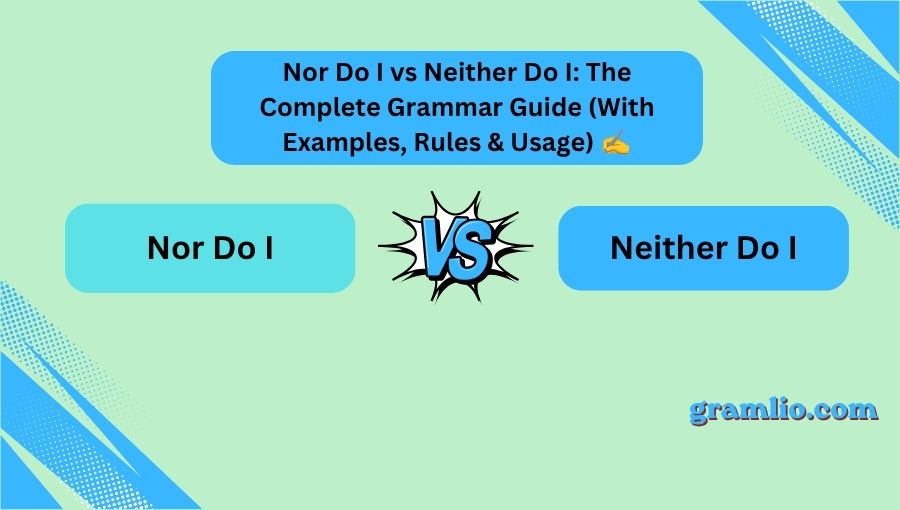
Nor Do I vs Neither Do I: The Complete Grammar Guide (With Examples, Rules & Usage) ✍️
The difference between Nor Do I vs Neither Do I is one of the most confusing parts of English grammar for learners and even native speakers. These two expressions both appear in negative agreement sentences, but their usage depends on tone, structure, and level of formality. 🤔
At first glance, Nor Do I vs Neither Do I may seem completely interchangeable, but subtle grammar rules decide when each one is correct. Many people mix them up in speaking, writing, emails, and exams, which can lead to unnatural or incorrect English usage.
Understanding Nor Do I vs Neither Do I is essential if you want to sound fluent, natural, and grammatically accurate in English communication. Whether you’re chatting casually, writing professionally, or preparing for tests, mastering this difference will improve your confidence and clarity.
In this article, you will learn everything from meanings and rules to real-life examples, common mistakes, and expert tips—so you will never confuse Nor Do I vs Neither Do I again. 📘✨
Quick Answer: Nor Do I vs Neither Do I

“Nor do I” and “Neither do I” both mean that you agree with a negative statement made by someone else.
- Neither do I is more common in everyday conversation and is used after a negative statement.
- Nor do I is more formal and usually follows a negative clause or inversion structure.
👉 In simple terms: both mean “I also don’t”, but “neither do I” is more natural in casual speech, while “nor do I” is more formal and structured.
Understanding the Basics of Nor Do I vs Neither Do I
To fully understand nor do I vs neither do I, you need to know how agreement in negative sentences works.
When someone says a negative sentence like:
“I don’t like coffee.”
And you want to agree, you don’t say:
❌ “I don’t like coffee too.”
Instead, you say:
✔ “Neither do I.” or ✔ “Nor do I.”
🔑 Core Idea
Both expressions:
- Express agreement with a negative statement
- Mean “I also do not…”
- Are used in response to negative sentences
Comparison Table: Nor Do I vs Neither Do I
| Feature | Neither do I | Nor do I |
|---|---|---|
| Form | Standard response phrase | Inverted / formal structure |
| Type | Conversational English | Formal / literary English |
| Meaning | I also don’t | I also don’t |
| Usage | Common in speech | Less common, more formal |
| Example | “I don’t like tea.” → “Neither do I.” | “I don’t like tea.” → “Nor do I.” |
| Correct/Incorrect | Correct in most cases | Correct but context-dependent |
Correct Meanings & Uses
1. Using “Neither do I” (Most Common Usage)
“Neither do I” is the most natural and widely used form in spoken English.
📌 Structure:
Negative statement + Neither + auxiliary verb + subject
Example:
- A: “I don’t like horror movies.”
- B: “Neither do I.”
Sentence Breakdown:
- Neither = also not
- do = auxiliary verb (matches tense)
- I = subject
💡 Test Tip:
If you’re unsure, ask:
👉 “Would I say this in a conversation with a friend?”
If yes, use Neither do I.
2. Using “Nor do I” (More Formal Usage)
“Nor do I” is grammatically correct but more formal and less commonly used in casual speech.
📌 Structure:
Used after a negative clause, often with inversion:
Nor + auxiliary verb + subject
Example:
- “I cannot attend the meeting. Nor do I wish to.”
Sentence Breakdown:
- Nor = and not / also not
- do I = inverted structure for emphasis
💡 Test Tip:
If the sentence sounds like formal writing, legal text, or literature, “Nor do I” fits better.
Case Study Section: Real-Life Usage Example
💼 Workplace Email Scenario
Email from Manager:
“I don’t think the report is ready for submission.”
Response 1 (Casual):
“Neither do I.”
Response 2 (Formal):
“Nor do I believe it is ready for submission.”
📊 Analysis:
- “Neither do I” → short, natural, conversational
- “Nor do I” → expanded, formal, professional tone
This shows how context determines which expression is better.
Grammar Rules Explanation
To understand nor do I vs neither do I, we need to look at grammar structure rules.
Rule 1: Negative Agreement Rule
When agreeing with a negative statement:
- Use “neither” or “nor”
- Avoid double negatives like “I don’t… too”
Rule 2: Auxiliary Verb Matching
The verb used must match the original sentence:
- I don’t → neither do I
- I didn’t → neither did I
- I can’t → neither can I
Rule 3: Inversion Rule (for “Nor do I”)
After “nor,” English often uses inversion:
- Nor do I agree
- Nor can I help
- Nor will I go
📚 According to standard grammar references (including widely accepted guides like Merriam-Webster usage notes), “neither” is preferred in everyday agreement, while “nor” is more formal and typically follows negative clauses or paired structures.
Common Mistakes
Many learners confuse these expressions due to similarity.
❌ Common Errors:
- “I don’t like it too” ❌
- “Nor I do” ❌
- “Neither I do” ❌
✔ Correct Forms:
- “Neither do I”
- “Nor do I”
Why These Mistakes Happen
1. Fast Typing ⌨️
People type quickly and rely on instinct instead of grammar rules.
2. Autocorrect Issues 📱
Phones may incorrectly predict sentence structures.
3. Lack of Grammar Knowledge 📘
Many learners are never explicitly taught inversion rules.
Similar Grammar Confusions Table
| Confused Forms | Correct Usage |
|---|---|
| its / it’s | It’s = it is, its = possessive |
| your / you’re | you’re = you are |
| their / there / they’re | different meanings |
| nor do I / neither do I | both mean “I also don’t” |
Usage in Different Contexts
🗣 Everyday Conversation
- “I don’t want pizza.”
- “Neither do I.”
💼 Professional Writing
- “The system is not ready.”
- “Nor do I believe it meets requirements.”
✍️ Creative Writing
- Dialogue uses “neither do I” more often for natural flow.
📱 Social Media/Texting
- Short form preferred:
- “Neither do I 😅”
Why It Matters (Important)
Understanding nor do I vs neither do I is important because it improves:
- ✔ Communication clarity
- ✔ Writing professionalism
- ✔ Grammar accuracy in emails and exams
- ✔ Natural English fluency
“Good grammar is the foundation of clear communication.”
Even small mistakes can change how your writing is perceived in formal contexts.
Special Exception
There are no major exceptions, but note:
- In very poetic or literary writing, “nor do I” may appear more frequently.
- In spoken English, “neither do I” dominates almost entirely.
Quick Recap Checklist
| Question | If Yes → Use |
|---|---|
| Is it a casual conversation? | Neither do I |
| Is it formal writing? | Nor do I |
| Do you want natural speech? | Neither do I |
| Do you want emphasis/literary tone? | Nor do I |
Practice Examples:
- “I don’t understand this rule.” → ________
- “I cannot attend.” → ________
- “I don’t agree.” → ________
✔ Answers:
- Neither do I
- Nor do I (formal), Neither do I (casual)
- Neither do I
FAQs: Nor Do I vs Neither Do I
1. What is the difference between nor do I and neither do I?
Both mean “I also don’t,” but “neither do I” is more common in conversation, while “nor do I” is more formal.
2. Can I use nor do I in speaking?
Yes, but it may sound slightly formal or uncommon in casual speech.
3. Which one is more correct?
Both are grammatically correct. Usage depends on context, not correctness.
4. Can neither do I be used in writing?
Yes, especially in informal or neutral writing like emails and blogs.
5. Why do people confuse nor and neither?
Because both express negative agreement and have similar meanings.
6. Is it wrong to say I don’t either?
It is not wrong, but “neither do I” is more grammatically natural.
Conclusion
Understanding the difference between nor do I vs neither do I is a small but powerful step toward mastering natural English grammar. Both expressions serve the same purpose—agreeing with a negative statement—but their usage depends on tone and context.
“Neither do I” is the go-to choice for everyday conversations, making it sound natural, simple, and fluent. On the other hand, “nor do I” adds a formal or literary touch and is often used in structured writing or emphasis.
By learning when to use each form, you improve not only your grammar accuracy but also your communication style. Whether you’re speaking casually with friends or writing professionally, choosing the right expression makes your English clearer and more polished.
Mastering such small distinctions is what separates basic English from confident, fluent communication. Keep practicing, and soon these phrases will become second nature. ✨
Also Read This: Hail vs Hale

I’m Julian Crestwood, and I work at Gramlio. I’m an expert in grammar and help learners write confidently with easy and practical guidance.