Unalienable vs Inalienable: Meaning, Difference, and Correct Usage Explained 🇺🇸📚
The confusion around unalienable vs inalienable is very common in English grammar, law, and academic writing. Many readers see both words used in different texts and assume they have different meanings, but that is not entirely true. These two terms are closely related and often interchangeable, yet their usage depends on historical and modern context. 🤔
Have you ever read a legal or historical document and noticed the phrase “unalienable vs inalienable” and wondered why two different spellings exist for the same idea? You are not alone. These words appear frequently in discussions about human rights, freedom, and constitutional law, especially when describing rights that cannot be taken away or surrendered.
The confusion becomes stronger when we see that the U.S. Declaration of Independence uses “unalienable rights,” while modern legal writing prefers “inalienable rights.” So, what is the real difference between them? Are they truly different, or just spelling variations? In this article, we will break everything down in simple US English, with examples, tables, and real-world usage so you can finally master unalienable vs inalienable with confidence. ✨
Quick Answer: Unalienable vs Inalienable
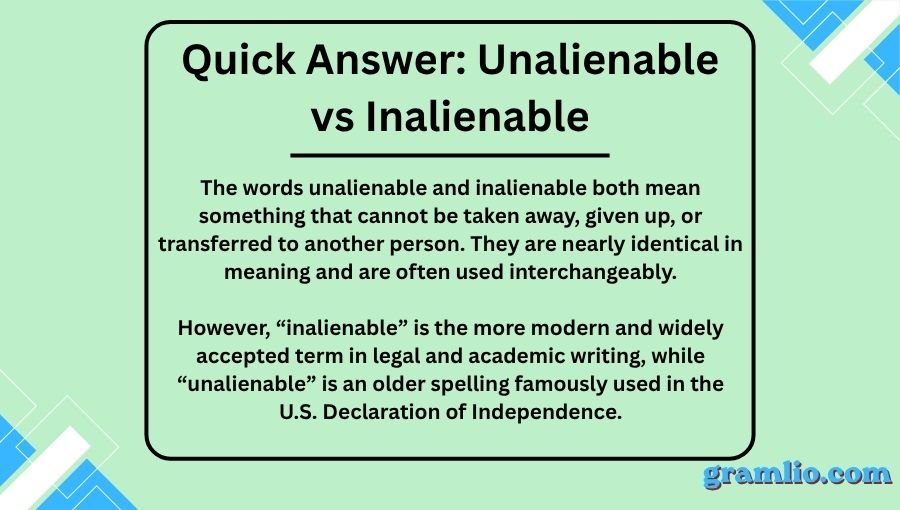
The words unalienable and inalienable both mean something that cannot be taken away, given up, or transferred to another person. They are nearly identical in meaning and are often used interchangeably.
However, “inalienable” is the more modern and widely accepted term in legal and academic writing, while “unalienable” is an older spelling famously used in the U.S. Declaration of Independence.
Understanding the Basics: Unalienable vs Inalienable
To truly understand unalienable vs inalienable, we must break the words into their structure and usage.
What does “Inalienable” mean?
The word inalienable comes from Latin roots:
- in- = not
- alienare = to transfer or alienate
👉 So, inalienable means something that cannot be transferred, surrendered, or taken away under any circumstances.
Example:
- Humans have inalienable rights such as freedom of speech and liberty.
What does “Unalienable” mean?
Unalienable carries the same meaning but uses a different prefix:
- un- = not
- alienable = able to be transferred
👉 So, unalienable also means something that cannot be taken away or given up.
Example:
- The Declaration of Independence states that people have unalienable rights.
Comparison Table: Unalienable vs Inalienable
| Feature | Unalienable | Inalienable |
|---|---|---|
| Form | Older English form | Modern standard form |
| Type | Adjective | Adjective |
| Meaning | Cannot be taken away or transferred | Cannot be taken away or transferred |
| Example | Unalienable rights in Declaration of Independence | Inalienable human rights |
| Correct Usage | Historically correct | Modern legal/academic usage |
Correct Meanings & Uses
1. Inalienable Rights 🌍
“Inalienable” is commonly used in modern law, politics, and human rights discussions.
Example sentence:
- Every human being has inalienable rights that must be protected by law.
Sentence breakdown:
- Every human being → subject
- has → verb
- inalienable rights → object (cannot be removed or transferred)
👉 This form is widely accepted in international law and documents.
2. Unalienable Rights 📜
“Unalienable” is mostly historical and symbolic today.
Example sentence:
- The founders of the United States believed in unalienable rights such as life, liberty, and the pursuit of happiness.
Sentence breakdown:
- The founders → subject
- believed in → verb phrase
- unalienable rights → object
👉 This spelling is strongly tied to the U.S. founding documents.
Test Tip 🧠
If you are writing modern academic, legal, or formal content:
- Use inalienable
If you are quoting historical American documents:
- Use unalienable
Case Study: Real-Life Usage Example 💼
Imagine you are writing an email for a human rights organization:
Wrong usage:
We must protect all citizens’ unalienable rights under international law.
Correct usage:
We must protect all citizens’ inalienable rights under international law.
Now imagine a historical essay:
Correct usage:
The Declaration of Independence famously refers to “unalienable rights.”
👉 This shows that context determines which word is appropriate.
Grammar Rules Explanation 📘
Both words are adjectives formed from the root word alienable, meaning “able to be transferred.”
Why “Inalienable” is preferred today:
- It follows standard Latin-based legal terminology.
- It is used in international law, dictionaries, and academic writing.
Why “Unalienable” still exists:
- It is a historical variant.
- It was used by Thomas Jefferson in the U.S. Declaration of Independence.
According to Merriam-Webster Dictionary, both words are considered correct in meaning, but inalienable is more commonly used in modern English.
Common Mistakes ⚠️
Many people confuse or misuse these terms due to:
- Fast typing ⌨️
- Autocorrect errors 📱
- Lack of grammar awareness 📚
Common Confusion Table
| Mistake Type | Incorrect Example | Correct Example |
|---|---|---|
| It’s/Its confusion | It’s rights are protected | Its rights are protected |
| Your/You’re confusion | Your protected by law | You’re protected by law |
| Unalienable/Inalienable | Unalienable law rights | Inalienable human rights |
👉 These mistakes often happen in rushed writing or social media posts.
Usage in Different Contexts 🌐
1. Everyday Conversation 🗣️
- “Everyone should know their inalienable rights.”
2. Professional Writing 💼
- “The organization defends inalienable human rights worldwide.”
3. Creative Writing ✍️
- “Freedom felt like an inalienable gift from nature itself.”
4. Social Media 📱
- “Protect your inalienable rights! #HumanRights”
Why It Matters (Important) ⚖️
Understanding the difference between unalienable vs inalienable is not just about grammar—it impacts clarity, professionalism, and credibility.
✔ Clear communication avoids misunderstandings
✔ Proper word choice improves writing quality
✔ Correct usage enhances professional image
“Language precision is the foundation of clear thinking.”
Using the correct term shows respect for legal and historical context.
Special Exception 📌
There is no strict rule banning either word. However:
- Legal systems, courts, and international documents prefer inalienable
- Historical U.S. texts preserve unalienable
So, the “exception” is mainly historical tradition vs modern standardization.
Quick Recap Checklist ✅
| Question | If Yes → Use |
|---|---|
| Are you writing modern law or academic content? | Inalienable |
| Are you quoting U.S. founding documents? | Unalienable |
| Is meaning “cannot be taken away”? | Either (prefer inalienable) |
Practice Examples ✏️
- Humans have ______ rights under international law.
👉 Answer: Inalienable - The Declaration mentions ______ rights.
👉 Answer: Unalienable - Freedom is considered ______.
👉 Answer: Inalienable
FAQs (Frequently Asked Questions) ❓
1. Are unalienable and inalienable the same?
Yes, both mean “cannot be taken away or transferred.” The difference is mainly historical usage.
2. Which word is more correct today?
“Inalienable” is more commonly used in modern English and legal writing.
3. Why does the U.S. Declaration use “unalienable”?
It reflects 18th-century English spelling preferences and historical style.
4. Can I use both words interchangeably?
Yes, but it is better to use “inalienable” in modern contexts.
5. Is “unalienable rights” still grammatically correct?
Yes, it is grammatically correct but less commonly used today.
6. What does inalienable rights mean in simple words?
It means rights that no one can take away from you.
Conclusion
The debate of unalienable vs inalienable often confuses readers, but the truth is simple: both words carry the same powerful meaning—something that cannot be taken away, sold, or transferred. The difference lies not in meaning but in usage and history.
“Unalienable” is an older form famously used in the United States Declaration of Independence, giving it strong historical significance. On the other hand, “inalienable” is the modern, widely accepted term used in law, education, and international human rights discussions.
If you are writing today, especially in academic, professional, or legal contexts, “inalienable” is the safer and preferred choice. However, when referring to historical documents, “unalienable” remains perfectly valid.
Understanding this distinction improves your grammar accuracy, strengthens your writing clarity, and helps you communicate more effectively. In the end, both words remind us of one powerful idea: some rights are so fundamental that they can never be taken away. 🌍✨
Also Read This: Afflict vs Inflict

I’m Julian Crestwood, and I work at Gramlio. I’m an expert in grammar and help learners write confidently with easy and practical guidance.