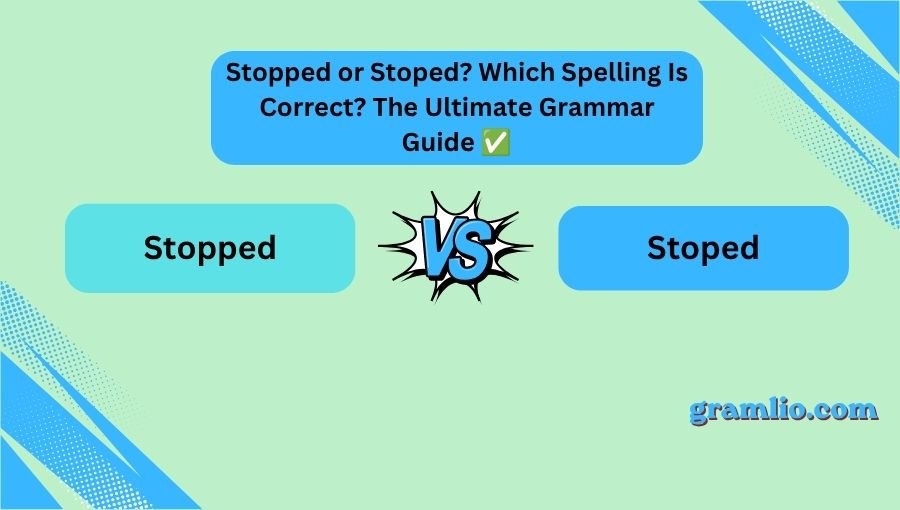
Stopped or Stoped? Which Spelling Is Correct? The Ultimate Grammar Guide ✅
Have you ever typed “stoped” in a text message, email, or school assignment and immediately seen a red spelling underline? 🤔 If yes, you’re certainly not the only one. One of the most common spelling questions English learners and native speakers ask is whether they should write Stopped or Stoped.
At first glance, both spellings may seem reasonable. After all, many English verbs simply add -ed to form the past tense. So why doesn’t stop become stoped? The answer lies in an important spelling rule that every English writer should know.
Understanding the difference between Stopped or Stoped will improve your writing accuracy, help you avoid common grammar mistakes, and make your communication appear more professional. Whether you’re writing an academic paper, a business email, a blog post, or a social media update, using the correct spelling shows attention to detail and confidence in your language skills.
In this comprehensive guide, you’ll learn exactly why stopped is correct, why stoped is incorrect in standard English, how the spelling rule works, practical examples, expert grammar tips, and common mistakes to avoid. By the end, you’ll never hesitate over Stopped or Stoped again. ✨
Quick Answer: Stopped or Stoped?
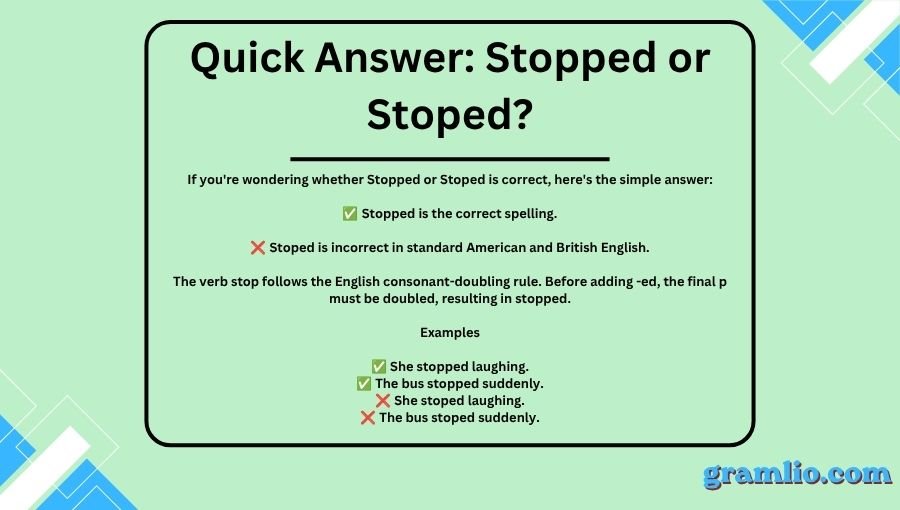
If you’re wondering whether Stopped or Stoped is correct, here’s the simple answer:
✅ Stopped is the correct spelling.
❌ Stoped is incorrect in standard American and British English.
The verb stop follows the English consonant-doubling rule. Before adding -ed, the final p must be doubled, resulting in stopped.
Examples
- ✅ She stopped laughing.
- ✅ The bus stopped suddenly.
- ❌ She stoped laughing.
- ❌ The bus stoped suddenly.
Also read: Emersion vs Immersion
Understanding the Basics of Stopped or Stoped
The confusion between Stopped or Stoped comes from how English forms the past tense of regular verbs.
Some verbs only require adding -ed.
Examples include:
- Walk → Walked
- Clean → Cleaned
- Jump → Jumped
However, some verbs require the final consonant to be doubled before adding -ed.
The verb stop belongs to this group.
Comparison Table: Stopped or Stoped
| Form | Type | Meaning | Example | Correct? |
|---|---|---|---|---|
| Stop | Base verb | To end an action or movement | Please stop talking. | ✅ |
| Stopped | Past tense / Past participle | Ended an action | We stopped at the park. | ✅ |
| Stoped | Misspelling | No accepted meaning in standard English | We stoped early. | ❌ |
The comparison clearly shows that stopped is the only correct spelling when referring to the past tense or past participle of stop.
Stopped or Stoped: Why Is “Stopped” Correct?
The answer comes from a standard English spelling rule.
When a one-syllable verb ends with:
- one short vowel
- followed by one consonant
you double the final consonant before adding -ed or -ing.
The word stop follows this exact pattern.
Structure:
- s
- t
- o (short vowel)
- p (single consonant)
Therefore:
Stop + ped = ❌ Incorrect
Stop + p + ed = Stopped ✅
The Consonant-Doubling Rule Explained
Many learners memorize spellings without understanding why they work.
Instead, learn the rule.
Rule
Double the last consonant when all three conditions are true:
- The word has one syllable.
- It ends with one vowel followed by one consonant.
- The suffix begins with a vowel, such as -ed or -ing.
Examples
| Base Verb | Past Tense | Present Participle |
|---|---|---|
| Stop | Stopped | Stopping |
| Plan | Planned | Planning |
| Drop | Dropped | Dropping |
| Hug | Hugged | Hugging |
| Slip | Slipped | Slipping |
This is why Stopped or Stoped has only one correct answer: stopped.
Stopped or Stoped in Everyday English
You will see stopped almost everywhere in English.
Everyday Conversation 😊
- We stopped for lunch.
- She stopped talking.
- They stopped arguing.
At School 🎓
- The teacher stopped the lesson.
- The students stopped making noise.
At Work 💼
- Production stopped yesterday.
- The software stopped responding.
- The meeting stopped after two hours.
While Traveling ✈️
- The train stopped at every station.
- Our taxi stopped outside the hotel.
No matter the situation, stoped is never the correct spelling for the verb stop.
Correct Meanings and Uses of Stopped
1. Stopped Means “Came to a Halt”
This is the most common meaning.
Examples
- The car stopped at the traffic light.
- The elevator stopped between floors.
Sentence Breakdown
The car stopped suddenly.
Subject: The car
Verb: stopped
Meaning: The vehicle came to a halt.
2. Stopped Means “Ended an Activity”
Examples
- She stopped crying.
- They stopped exercising.
- We stopped watching television.
Here, stopped means an activity came to an end.
3. Stopped Means “Prevented Something”
Sometimes stopped means prevented.
Examples
- The police stopped the robbery.
- A firewall stopped the cyberattack.
- His quick thinking stopped an accident.
4. Stopped in Phrasal Verbs
The verb also appears in common expressions.
Examples
- stopped by
- stopped over
- stopped off
Example sentences
- I stopped by your office.
- We stopped over in Chicago.
- They stopped off for coffee.
Test Tip for Remembering Stopped or Stoped 📝
Whenever you’re unsure, ask yourself these questions:
✅ Is the base word stop?
✅ Am I writing the past tense?
✅ Am I adding -ed?
If the answer is yes, double the final p.
Stop → Stopped
Never write stoped.
A quick memory trick:
One vowel + one consonant = Double before -ed.
Case Study: Business Email Example
Imagine two employees sending an email to a client.
Email 1
The production line stoped working at 9:15 this morning.
Although understandable, this spelling mistake makes the email look careless.
Email 2
The production line stopped working at 9:15 this morning.
The second email appears polished, professional, and grammatically correct.
A single letter can influence how readers judge your writing.
Grammar Authority: What Do Dictionaries Say?
Leading grammar references agree that stopped is the correct spelling.
For example:
- Merriam-Webster lists stopped as the past tense and past participle of stop.
- Cambridge Dictionary uses stopped in all standard examples.
- Oxford Learner’s Dictionary also recognizes stopped as the correct form.
You will not find stoped listed as the standard past tense of stop.
This consistency across trusted dictionaries makes the answer to Stopped or Stoped straightforward.
Common Mistakes When Choosing Stopped or Stoped
Many people accidentally type stoped for simple reasons.
Fast Typing ⚡
When typing quickly, it’s easy to forget to double the final p.
Example
❌ I stoped reading.
✅ I stopped reading.
Autocorrect Problems 📱
Some devices may not immediately correct every spelling error, especially if a custom dictionary has learned the incorrect form.
Lack of Grammar Knowledge 📚
Many learners assume every regular verb only needs -ed.
That works for:
- Walk → Walked
- Jump → Jumped
But not for:
- Stop → Stopped
Influence from Other Languages 🌍
Some languages form the past tense differently, making English spelling rules more difficult to remember.
Similar Grammar Mistakes
| Incorrect | Correct | Reason |
|---|---|---|
| Stoped | Stopped | Missing doubled consonant |
| Begining | Beginning | Missing doubled consonant |
| Planed | Planned | Missing doubled consonant |
| Runing | Running | Missing doubled consonant |
| It’s | Its | Apostrophe confusion |
| Your | You’re | Homophone confusion |
| Than | Then | Similar pronunciation |
| Loose | Lose | Similar spelling |
Usage in Different Contexts: Stopped or Stoped
Understanding the correct spelling of Stopped or Stoped becomes even more important when writing for different audiences. Whether you’re chatting with friends, writing a business proposal, or posting online, using stopped correctly improves clarity and credibility.
Everyday Conversation 😊
In daily conversations, stopped is commonly used to describe actions that ended or paused.
Examples
- I stopped by the grocery store after work.
- She stopped laughing when the teacher entered.
- We stopped watching the movie because it was too late.
- The rain finally stopped this afternoon.
These examples sound natural because stopped is the standard past tense of stop.
Professional Writing 💼
Professional communication requires correct spelling and grammar. A simple error like stoped can make reports, emails, and proposals appear careless.
Examples
- The project stopped due to budget constraints.
- Production stopped temporarily because of equipment maintenance.
- Customer support stopped accepting requests after business hours.
- The system stopped responding during the update.
Using stopped correctly helps maintain professionalism and builds trust with readers.
Academic Writing 🎓
Teachers, professors, and examiners expect proper grammar.
Examples
- The experiment stopped after thirty minutes.
- The researchers stopped collecting data once the target sample size was reached.
- The discussion stopped because the allotted time had ended.
Correct spelling contributes to higher-quality academic writing.
Creative Writing ✍️
Writers use stopped to create emotion, suspense, or vivid imagery.
Example
Emma stopped at the edge of the old bridge. The wind grew stronger, and silence filled the empty valley. For a moment, even time seemed to have stopped.
Using the correct spelling keeps readers focused on the story rather than distracted by mistakes.
Social Media and Text Messages 📱
Even in casual communication, good spelling leaves a positive impression.
Examples
- Finally stopped procrastinating! 🎉
- We stopped for coffee before the trip. ☕
- My phone stopped working again. 😅
Although social media often contains informal language, stopped remains the correct spelling.
Why Correctly Choosing Stopped or Stoped Matters
Some people believe spelling mistakes are unimportant. In reality, accurate spelling improves communication in several ways.
Clear Communication
Correct spelling allows readers to understand your message immediately.
For example:
✅ The machine stopped working.
❌ The machine stoped working.
Although most readers understand the second sentence, the error interrupts the reading experience.
Professionalism
Correct grammar reflects attention to detail.
Whether you’re applying for a job, communicating with clients, or writing an important email, using stopped instead of stoped demonstrates professionalism.
Writing Accuracy
Accurate spelling strengthens every type of writing.
Benefits include:
- Better readability
- Improved credibility
- Stronger academic performance
- Higher-quality business communication
- More polished online content
Better Digital Communication
Grammar checkers, AI writing tools, search engines, and readers all recognize standard spelling.
Correct spelling can also improve:
- User experience
- Search engine optimization (SEO)
- Reader trust
- Content quality
“Clear writing begins with correct words.” ✨
Special Exception: Is There Ever a Time When “Stoped” Is Correct?
There is one rare exception.
The word stope is a mining term.
A stope is an underground excavation where miners remove ore.
Because stope is its own verb, its past tense can be written as stoped in specialized mining contexts.
Example
The miners stoped the chamber before beginning extraction.
However, this usage is extremely rare and appears almost exclusively in technical mining literature.
For everyday English, business writing, education, journalism, blogging, and conversation, stopped is always the correct spelling.
Memory Tricks for Remembering Stopped or Stoped 🧠
Learning a few simple tricks makes the spelling easy to remember.
Trick 1
Short vowel + single consonant = double the consonant.
Stop
↓
Stopped
Trick 2
Think of similar verbs.
- Stop → Stopped
- Drop → Dropped
- Plan → Planned
- Hug → Hugged
Notice the same pattern.
Trick 3
Say it aloud.
The pronunciation naturally emphasizes the doubled consonant sound.
Quick Recap Checklist
| Question | If Yes → Use |
|---|---|
| Is the base verb stop? | Stopped ✅ |
| Are you writing about the past? | Stopped ✅ |
| Are you using the past participle? | Stopped ✅ |
| Are you writing “stoped”? | Change it to stopped ✅ |
| Are you writing standard English? | Stopped ✅ |
Practice Exercises
Fill in the blank with the correct spelling.
1.
The bus ______ outside the museum.
✅ Answer: stopped
2.
She has ______ eating fast food.
✅ Answer: stopped
3.
Traffic ______ because of the accident.
✅ Answer: stopped
4.
We ______ talking when the teacher entered.
✅ Answer: stopped
5.
The clock suddenly ______.
✅ Answer: stopped
Quick Quiz
Choose the correct sentence.
Question 1
A. The rain stoped.
B. The rain stopped.
✅ Correct Answer: B
Question 2
A. They stopped working.
B. They stoped working.
✅ Correct Answer: A
Question 3
A. She has stopped smoking.
B. She has stoped smoking.
✅ Correct Answer: A
FAQs
1. Which is correct: Stopped or Stoped?
Stopped is the correct spelling. It is the past tense and past participle of the verb stop. Stoped is considered a spelling error in standard English.
2. Why is “stopped” spelled with two Ps?
The final p is doubled because stop is a one-syllable verb ending with a short vowel followed by a single consonant. According to English spelling rules, the consonant is doubled before adding -ed.
3. Is “stoped” ever accepted?
Only in the rare context of the mining verb stope. It is not correct as the past tense of the everyday verb stop.
4. Is “stopped” used in both American and British English?
Yes. Both American English and British English use stopped. There is no spelling difference between the two varieties.
5. Is “stopped” a regular verb?
Yes. The verb stop is a regular verb, but it follows the consonant-doubling rule when adding -ed or -ing.
Examples:
- Stop → Stopped
- Stop → Stopping
6. How can I avoid writing “stoped” by mistake?
Remember this simple formula:
One short vowel + one consonant = Double the consonant before adding -ed.
Practice with similar verbs like drop, plan, hug, and slip to reinforce the pattern.
Conclusion
The debate over Stopped or Stoped has a simple answer: stopped is the correct spelling in standard English. The form stoped is almost always a spelling mistake because the verb stop follows the consonant-doubling rule before adding -ed.
Once you understand this rule, you’ll also find it easier to spell many other verbs correctly, including planned, dropped, hugged, and slipped. Rather than memorizing individual words, focus on the underlying grammar pattern. This approach improves both your spelling and your confidence as a writer.
Whether you’re writing an email, completing homework, publishing a blog post, or posting on social media, choosing stopped ensures your writing is clear, professional, and grammatically accurate.
Whenever you hesitate between Stopped or Stoped, remember this simple rule:
Short vowel + single consonant + -ed = Double the consonant.
So the next time you write about something that came to an end, you’ll know exactly which spelling to use:
Stop → Stopped. ✅
With this rule in mind, you’ll avoid one of the most common English spelling mistakes and write with greater confidence every time.

I’m Ethan Holloway, and I work at Gramlio. I’m an expert in grammar and focus on making confusing English rules easy to understand.