What Does MIS Mean? Meaning, Context, Examples, and Modern Usage (2026 Guide)
Imagine you’re reading a job posting and see “MIS experience required.” Later that day, a friend sends “MIS” in a message, and you wonder whether it means the same thing. That’s where this short abbreviation can get confusing. So, what does MIS mean? MIS most commonly stands for Management Information Systems, especially in business, education, technology, and workplace settings.
It can also have other meanings depending on the industry or the conversation.
People continue searching for this term because MIS appears across college programs, job descriptions, company departments, software discussions, reports, and online conversations. The rise of data-driven business has also made information systems a familiar part of everyday professional language.
One useful observation is that the words surrounding an abbreviation often tell you more than the abbreviation itself. “MIS department” points toward business technology, while a casual message may require more context.
The sections below break down the main definition, less common meanings, social usage, conversation examples, potential misunderstandings, and practical ways to interpret the term correctly.
Quick Answer / Quick Definition of “What Does MIS Mean”

MIS usually means Management Information Systems. It refers to the people, technology, processes, and data used to collect, organize, analyze, and deliver information for business decisions. In college and workplace settings, MIS commonly describes a field of study, business function, or information system.
Also read: HBU Meaning in Text
Detailed Meaning Breakdown
Primary Meaning
The most common meaning of MIS is Management Information Systems.
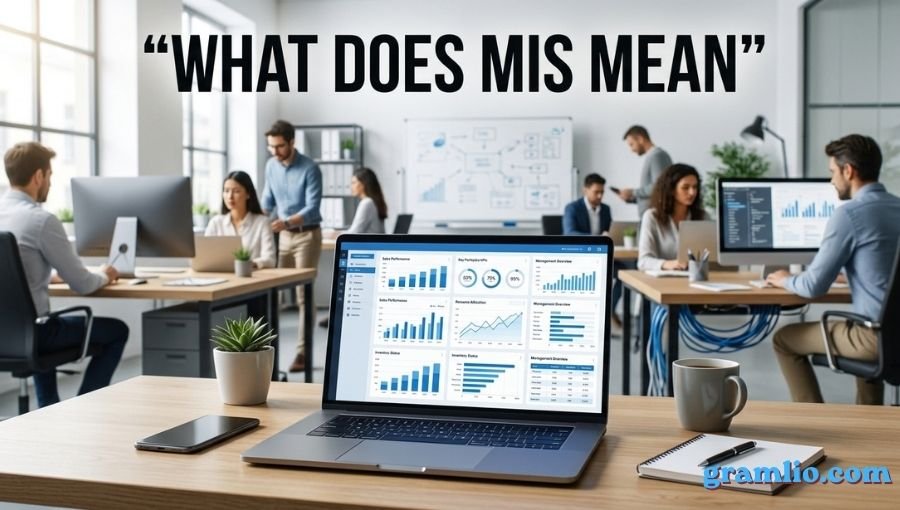
An MIS combines technology, data, people, and business processes to help an organization operate and make informed decisions. For example, a company might use an information system to track sales, inventory, employee performance, customer activity, or financial information.
MIS isn’t simply another name for a computer. A computer is a tool. An information system connects people, processes, technology, and information to accomplish a business purpose.
A manager might receive a weekly sales report generated through an MIS. The system gathers raw information, processes it, and presents useful results.
That’s why MIS sits between business management and information technology. It isn’t purely about coding, nor is it purely about management.
Secondary Meanings
The exact expansion of MIS can change by industry.
In education, MIS often refers to a Management Information Systems degree or academic program. A student studying MIS may learn subjects such as databases, business analytics, systems analysis, cybersecurity, project management, and enterprise technology.
In a company, MIS can refer to an MIS department or team. That group may prepare reports, maintain business systems, manage data, support applications, or help departments use technology effectively.
Some organizations also use MIS for specific internal systems or reporting functions. In those cases, the company itself may define the abbreviation differently.
Rare or Misinterpreted Meanings
MIS doesn’t have one universal meaning in every conversation.
A common mistake is assuming that every appearance of “MIS” refers to Management Information Systems. Acronyms are highly context-dependent, and organizations sometimes create their own shorthand.
There’s another important point: MIS isn’t a widely standardized texting abbreviation in the way terms such as “LOL,” “BRB,” or “IDK” are.
If someone sends only “MIS” in a personal message, don’t automatically assign a meaning. Look at the surrounding conversation, ask what they mean, or check whether the sender uses a known personal abbreviation.
What “What Does MIS Mean” Means in Different Contexts
In Texting and Messaging
In ordinary texting, MIS doesn’t have one universally accepted definition.
If a coworker texts, “Can you send the MIS report?” the meaning is probably related to a management information system or business report.
A friend writing only “MIS?” is different. Without context, the abbreviation could be a typo, an internal shorthand, or a reference understood only by that person.
For example:
“Did you finish the MIS assignment?”
Here, “MIS” almost certainly refers to the subject or course Management Information Systems.
The practical lesson is simple: don’t treat workplace abbreviations as universal texting slang.
On Social Media Platforms
On Instagram, Snapchat, TikTok, and Threads, MIS doesn’t have a single established meaning that everyone understands.
A person might mention “MIS” in a caption about a university major, a technology career, or a company department. Someone could also use the letters as private shorthand in a DM or group chat.
For example, an Instagram caption saying:
“Three years of MIS and finally graduated!”
would naturally suggest Management Information Systems.
A Snapchat message saying:
“Are you going to MIS tomorrow?”
could mean a class, event, organization, or person depending on the sender’s social circle.
On TikTok and Threads, context matters just as much. Don’t assume an acronym has a platform-specific meaning simply because it appears in a post.
In Dating and Relationships
MIS isn’t a standard romantic abbreviation.
If you see “MIS” in a dating conversation, the safest interpretation is context first rather than assuming it means something affectionate or romantic.
For instance:
“I have my MIS exam tomorrow, so I’ll call you later.”
Here, MIS clearly refers to an academic subject.
If someone simply writes:
“MIS ❤️”
there isn’t enough information to determine what the letters mean. The heart suggests an emotional tone, but it doesn’t establish a recognized definition for MIS.
In Professional Communication
This is where MIS is most commonly encountered.
A manager might say:
“Please send the MIS report before Friday.”
The phrase may refer to a report produced by a management information system, or to a particular reporting process inside the organization.
A job advertisement might say:
“Bachelor’s degree in MIS, IT, or business analytics preferred.”
Here, MIS means Management Information Systems as an academic discipline.
In professional writing, clarity matters. If your audience may not know the abbreviation, spell it out the first time:
Management Information Systems (MIS)
After that, MIS can be used consistently.
Cultural or Regional Differences
The core business meaning of MIS is broadly recognizable in English-speaking professional and academic environments, but local usage can vary.
Universities may name their programs differently. Companies may use MIS for specific departments or reports. Employees in one organization may understand an abbreviation that outsiders don’t.
This is especially noticeable in multinational workplaces, where English abbreviations can become internal shorthand.
A useful habit is to ask, “What does this organization mean by MIS?” rather than assuming every company uses the term identically.
Tone, Psychology & Why People Use It
Why People Use It & What It Signals Socially
People use MIS mainly because abbreviations make repeated professional terms faster to write and say.
Once employees understand “MIS,” typing the full phrase every time would feel unnecessary. The same applies to university students discussing their major.
In a workplace, using a familiar abbreviation can signal that someone understands the organization’s terminology. But excessive shorthand can have the opposite effect when the audience isn’t familiar with it.
I’ve found that the simplest rule works best: use abbreviations to save time, not to create confusion.
Emotional Layer Behind It
Unlike many internet abbreviations, MIS usually carries little emotional meaning by itself.
“LOL” can signal amusement. “OMG” can express surprise. MIS generally doesn’t communicate friendliness, anger, romance, or sarcasm on its own.
Tone comes from the surrounding words.
“Please update the MIS report.”
This sounds neutral and professional.
“Ugh, MIS exam tomorrow 😭”
Here, the emotional tone comes from “Ugh” and the crying emoji, not from MIS itself.
10 Real Conversation Examples (Explained)
1. Message: “I’m majoring in MIS.”
Meaning: The person studies Management Information Systems.
Tone: Informative and casual.
Likely interpretation: They’re talking about a college or career field.
2. Message: “The MIS report is ready.”
Meaning: A business information or management report has been completed.
Tone: Professional and neutral.
Likely interpretation: The recipient knows what report “MIS” refers to.
3. Message: “Do we have MIS class today?”
Meaning: The sender is asking about a Management Information Systems course.
Tone: Casual.
Likely interpretation: Common among students.
4. Message: “MIS experience required.”
Meaning: The job likely expects experience related to Management Information Systems.
Tone: Formal.
Likely interpretation: This is employment or recruitment language.
5. Message: “MIS helped me understand how businesses use data.”
Meaning: The speaker is discussing the academic or professional field.
Tone: Reflective.
Likely interpretation: They’re talking about education or career development.
6. Message: “Can you check MIS before the meeting?”
Meaning: The sender expects the recipient to review an internal information system, report, or dashboard.
Tone: Direct and workplace-oriented.
Likely interpretation: The company’s internal context defines the exact reference.
7. Message: “My MIS exam is Friday.”
Meaning: The sender has an exam in Management Information Systems.
Tone: Personal and conversational.
Likely interpretation: They’re discussing school.
8. Message: “Just posted my MIS graduation pics!”
Meaning: MIS is probably the person’s degree or major.
Tone: Celebratory.
Likely interpretation: Social-media context points toward education.
9. Message: “What does MIS stand for in this document?”
Meaning: The reader doesn’t know which definition applies.
Tone: Neutral and inquisitive.
Likely interpretation: The document needs clarification.
10. Message: “MIS?”
Meaning: Impossible to determine confidently without additional context.
Tone: Ambiguous.
Likely interpretation: Ask the sender rather than guessing.
Where Misunderstandings Happen
Context Confusion
The biggest problem is assuming an acronym has one fixed meaning everywhere.
A student, software developer, accountant, and company manager may encounter MIS in different situations. The surrounding words usually reveal which interpretation makes sense.
If the context isn’t enough, clarification is better than guessing.
Generational Gap
Different age groups can develop different communication habits.
Younger users may encounter abbreviations through school, social platforms, gaming, or group chats. Older professionals may know MIS primarily as a business or technology term.
That doesn’t mean one generation has a special definition. It simply means shared context matters.
Platform Differences
A LinkedIn post about a technology career provides a very different context from a private Snapchat message.
On LinkedIn, MIS is likely professional. On Instagram, it could describe someone’s degree. In a private message, the same three letters could be personal shorthand.
The platform helps, but it isn’t enough by itself.
Similar Words, Symbols, or Abbreviations
| Term | Meaning | How It Differs from What Does MIS Mean |
|---|---|---|
| MIS | Management Information Systems | Focuses on business information systems and related functions. |
| IT | Information Technology | Broader technology field covering infrastructure, systems, support, and more. |
| IS | Information Systems | A broader term for systems that manage information and organizational processes. |
| ERP | Enterprise Resource Planning | Integrated software used to manage major business functions. |
| BI | Business Intelligence | Focuses on analyzing data to produce business insights. |
| CRM | Customer Relationship Management | Systems and processes focused on customer interactions and relationships. |
| DBMS | Database Management System | Software specifically designed to create, store, and manage databases. |
| AI | Artificial Intelligence | Technology that performs tasks associated with aspects of human intelligence. |
| MIA | Missing in Action | A completely different abbreviation commonly associated with someone being absent or unaccounted for. |
When Not to Use “What Does MIS Mean”
Professional Risks
Don’t use MIS without explanation when writing for people outside your organization.
A client may understand “information system” but have no idea what your internal MIS abbreviation represents. Spell out the term first when there’s reasonable doubt.
Cultural Risks
Avoid assuming that an abbreviation has the same meaning across countries, workplaces, schools, or communities.
If you’re communicating internationally, plain language is often safer than unexplained shorthand.
Tone Risks
MIS isn’t normally a problem in professional writing, but using unexplained abbreviations can make a message feel unnecessarily technical.
For a public audience, write:
Management Information Systems (MIS)
Then use MIS afterward.
Expert Tips for Using “What Does MIS Mean” Correctly
- Check the surrounding words before deciding what MIS means.
- Look at the setting: school, business, technology, social media, or personal messaging.
- Spell it out first when introducing MIS to a new audience.
- Don’t assume it’s texting slang. MIS isn’t a universal casual abbreviation.
- Check company terminology when reading an internal report or job description.
- Consider the speaker’s field. A business student may use MIS differently from a general social-media user.
- Ask for clarification when the message contains only “MIS.”
- Use the full term in formal documents when readers may not recognize the abbreviation.
- Don’t confuse MIS with MIA, IT, IS, or BI. Similar-looking abbreviations can have very different meanings.
- Let context determine the definition, rather than forcing a familiar meaning onto an unfamiliar conversation.
Frequently Asked Questions
1. What does MIS mean in simple words?
MIS usually means Management Information Systems. In simple terms, it’s the use of people, technology, processes, and data to provide useful information for running an organization. It can describe a college major, a business function, a department, or an information system used to create reports and support decisions.
2. Is MIS a positive or negative term?
MIS is generally a neutral professional and academic abbreviation. It doesn’t automatically express approval, criticism, happiness, or negativity. Its meaning depends on context. For example, “MIS degree” is educational, while “MIS report” is usually workplace-related. Any positive or negative feeling comes from the surrounding conversation.
3. Can MIS have a romantic meaning?
There is no broadly recognized romantic meaning for MIS. If you encounter it in a dating conversation, don’t assume the letters represent affection or attraction. The sender may be discussing school, work, or using private shorthand. Ask what they mean if the surrounding conversation doesn’t make the reference clear.
4. How should I respond when someone texts “MIS”?
Start by considering the conversation. If you’re discussing college, work, or technology, the intended meaning may be obvious. If the message is simply “MIS?” with no context, a natural response is: “What do you mean by MIS?” A short clarification can prevent an unnecessary misunderstanding.
5. What does MIS mean in college?
In college, MIS most commonly means Management Information Systems, an academic field combining business and technology. Programs may cover databases, systems analysis, business analytics, project management, information security, and enterprise systems. A student might say, “I’m an MIS major,” to describe their degree program.
6. What does MIS mean in a job description?
In a job posting, MIS usually refers to Management Information Systems. The employer may be seeking a degree, experience, or skills related to business systems, data, reporting, technology, or process improvement. The exact requirement depends on the position, so the job description should be read in full.
7. Is MIS the same as IT?
No. MIS and IT overlap, but they’re not identical. MIS traditionally emphasizes the relationship between technology, information, business processes, and management. IT is a broader technology field that can include infrastructure, technical support, networks, systems administration, cloud services, and other areas.
8. What does MIS mean on social media?
On social media, MIS has no single universal slang definition. It may refer to Management Information Systems when someone discusses school, work, or technology. In a personal post or DM, it could be an internal abbreviation. Context is essential, especially when the letters appear without an explanation.
Final Summary & Smart Usage Advice
So, what does MIS mean? In most business, education, and technology contexts, it means Management Information Systems. The term describes the combination of people, processes, technology, and information used to support organizational work and decision-making.
You’ll commonly see MIS when someone talks about a college major, business department, information system, report, job qualification, or technology-related career. That’s where the abbreviation has its clearest and most established use.
Personal messages are different. MIS isn’t a universally recognized texting or romantic abbreviation, so a short message containing only those three letters may be impossible to interpret accurately. Context should always come first.
The same principle applies across Instagram, Snapchat, TikTok, Threads, email, workplace chats, and academic conversations. Look at the words around the abbreviation. Consider who wrote it, where they wrote it, and what you were discussing.
When writing for a broad audience, introduce the phrase as Management Information Systems (MIS) before using the shortened form.
You now have the key distinction: MIS has a clear professional meaning, but its meaning can become uncertain when removed from context.
Memorable takeaway: When you see MIS, don’t guess from the letters alone—let the context tell you what they mean.

I’m Caleb Whitmore, and I work at Gramlio. I’m an expert in grammar and help readers understand English with simple explanations and real-life examples.