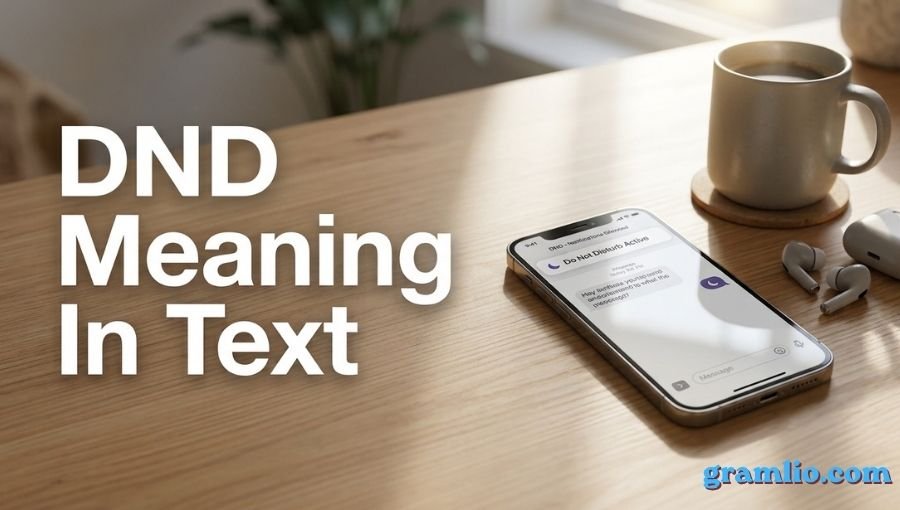
DND Meaning In Text: Definition, Context, Examples, and Modern Usage (2026 Guide)
You send a friend a message, see “DND” beside their name, and suddenly wonder whether they’re ignoring you. Maybe you notice the same abbreviation in a text, Instagram DM, or Snapchat story. DND meaning in text is usually simple, but the exact message can change depending on where and how someone uses it.
Most often, DND means “Do Not Disturb.” It can describe a phone setting, a person who doesn’t want notifications, or a request not to be interrupted. On some platforms, however, DND may refer to Dungeons & Dragons, the popular fantasy role-playing game.
The reason people search for this abbreviation is straightforward: short forms can carry different meanings in different conversations. A message such as “I’m on DND” isn’t necessarily rude, while “DND tonight?” could mean something entirely different among gamers.
Here’s a clear breakdown of the meaning, context, tone, examples, and common misunderstandings so you can interpret it confidently.
Quick Answer / Quick Definition of “DND Meaning In Text”

DND meaning in text most commonly refers to “Do Not Disturb.” It tells someone that a person doesn’t want to be interrupted or that notifications are being silenced. In gaming conversations, DND can also mean Dungeons & Dragons, so the surrounding context determines the intended meaning.
Also read: TGAT Meaning in Text
Detailed Meaning Breakdown
Primary Meaning
The most common meaning of DND in everyday texting is Do Not Disturb.
It can describe a phone’s notification mode or a person’s temporary wish for quiet. For example, someone might text, “Going DND for a few hours,” meaning they won’t be checking messages because they want uninterrupted time.
This meaning is especially common because smartphones use a Do Not Disturb mode to silence calls, alerts, and notifications.
A quick personal rule I use: if the conversation is about sleep, studying, work, driving, or needing space, “Do Not Disturb” is probably the answer.
Secondary Meanings
DND can also mean Dungeons & Dragons, usually written as D&D or DnD.
In a gaming group, “DND starts at 7” almost certainly means the role-playing game rather than a phone setting. Gamers commonly use the abbreviation when discussing campaigns, characters, dice, and game nights.
Another less common possibility is that someone is referring to a specific setting, feature, group name, or personal abbreviation. Context matters more than capitalization.
Rare or Misinterpreted Meanings
The biggest mistake is assuming DND always has one fixed definition.
For example, “Why didn’t you answer? I was on DND” clearly points toward Do Not Disturb. But “My DND character just leveled up” is about Dungeons & Dragons.
The abbreviation itself doesn’t reveal the answer. The words around it do.
What “DND Meaning In Text” Means in Different Contexts
In Texting and Messaging
In ordinary texts, DND usually communicates unavailability or reduced responsiveness.
Someone might write:
“Heading into a meeting. DND for an hour.”
They’re letting you know that delayed replies aren’t personal.
Another person may simply say:
“I’m on DND rn.”
Here, “rn” means “right now,” and the full message means they currently have notifications or interruptions turned off.
When interpreting DND meaning in text, look at the surrounding conversation. If someone was discussing being busy, tired, studying, or sleeping, the intended meaning is usually obvious.
On Social Media Platforms
On Instagram, someone might put “DND” in a bio, Story, caption, or DM to signal that they aren’t accepting messages at the moment.
On Snapchat, it may appear in a status or conversation when someone wants fewer interruptions.
On TikTok, “DND” in a caption or comment can mean Do Not Disturb, although gaming-related content may use it for Dungeons & Dragons.
On Threads, a post saying “DND this weekend” could simply mean the person wants uninterrupted personal time.
The platform rarely changes the definition itself. The content around the abbreviation does.
In Dating and Relationships
In romantic conversations, DND can have a stronger emotional effect.
A person might text:
“I’m going DND tonight. Need some time to myself.”
That doesn’t automatically mean they’re upset with their partner. It may simply mean they need quiet time.
However, context matters. If someone suddenly changes their communication habits and repeatedly says “DND” without explanation, the other person may interpret it as emotional distance.
The safest approach is not to guess. A calm question such as “No problem—should I check in tomorrow?” removes uncertainty without creating pressure.
In Professional Communication
DND is common in workplace communication when someone needs uninterrupted concentration.
For example:
“DND from 2–4 while I finish the report.”
That’s efficient and easy for coworkers to understand in an informal workplace.
Still, abbreviations can sound too casual in formal emails, client communication, or messages to people unfamiliar with workplace shorthand. In those situations, “Do Not Disturb” or “I’m unavailable until 4 p.m.” is clearer.
Cultural or Regional Differences
The core meaning is broadly understood in American digital communication, especially among smartphone users.
Age can make a difference, though. Younger users may recognize DND instantly from phone settings and messaging culture, while someone less familiar with digital abbreviations may prefer the full phrase.
Gaming communities also create a major context difference. A teenager discussing a campaign may use DnD constantly, while an office worker mentioning notifications probably means Do Not Disturb.
Tone, Psychology & Why People Use It
Why People Use It & What It Signals Socially
DND is useful because it communicates a boundary quickly.
Instead of explaining, “I don’t want to receive notifications because I need to concentrate for the next two hours,” someone can simply say, “DND for two hours.”
It can signal privacy, focus, rest, or temporary unavailability. In many cases, it’s actually considerate because the person is explaining why their response may be delayed.
I’ve found that the shortest messages can sometimes prevent the biggest misunderstandings when the context is clear.
Emotional Layer Behind It
The tone depends heavily on wording.
“DND while I study ❤️” feels friendly and temporary.
“DND. Don’t text me.” sounds much colder and more forceful.
“Going DND for the night” is generally neutral.
So, DND itself isn’t inherently positive or negative. The surrounding language determines the emotional layer.
10 Real Conversation Examples (Explained)
- Message: “I’m putting my phone on DND during the exam.”
Meaning: The sender won’t be checking notifications. Tone: Neutral and practical. The likely interpretation is that delayed replies aren’t personal. - Message: “DND tonight, I’m exhausted.”
Meaning: They want uninterrupted rest. Tone: Casual and tired rather than angry. - Message: “Can you go DND while we’re watching the movie?”
Meaning: They want fewer interruptions. Tone: Friendly, especially between close friends. - Message: “Why are you always on DND when I call?”
Meaning: The sender feels frustrated about communication. Tone: Potentially confrontational. - Message: “DND until 3. Finishing my presentation.”
Meaning: The person is unavailable while working. Tone: Professional but informal. - Message: “Our DND campaign starts at 8.”
Meaning: This refers to Dungeons & Dragons, not phone settings. Tone: Excited and social. - Message: “I’m on DND, but call if it’s urgent.”
Meaning: Notifications are limited, but emergencies are acceptable. Tone: Reassuring. - Message: “DND please, I need to clear my head.”
Meaning: The person wants emotional or mental space. Tone: Personal and serious. - Message: “DND for the next hour 😂.”
Meaning: They’re jokingly announcing temporary unavailability. Tone: Lighthearted. - Message: “My DND character is a wizard.”
Meaning: DND means Dungeons & Dragons here. Tone: Clearly related to gaming.
Where Misunderstandings Happen
Context Confusion
The biggest issue is that DND has two widely recognized meanings.
If someone says, “I’m playing DND tonight,” they’re probably talking about Dungeons & Dragons. If they say, “I’m putting my phone on DND,” they mean Do Not Disturb.
Read the entire sentence before deciding what the abbreviation means.
Generational Gap
People who regularly use smartphone settings may immediately understand DND as Do Not Disturb.
Someone who spends more time in gaming communities may first think of Dungeons & Dragons. Neither interpretation is wrong. The conversation decides which one fits.
Platform Differences
A gaming TikTok may use DND heavily for Dungeons & Dragons, while a workplace chat is more likely to use it for Do Not Disturb.
The platform provides a clue, but it isn’t proof. Always consider the topic of the conversation.
Similar Words, Symbols, or Abbreviations
| Term | Meaning | How It Differs from DND Meaning In Text |
|---|---|---|
| AFK | Away From Keyboard | Usually says someone is temporarily away, especially in gaming. |
| BRB | Be Right Back | Promises a return rather than simply limiting interruptions. |
| Busy | Currently occupied | More direct and less specific than DND. |
| Offline | Not currently connected | Doesn’t necessarily mean notifications are silenced. |
| DM | Direct Message | Describes a private message, not availability. |
| D&D | Dungeons & Dragons | Specifically identifies the tabletop role-playing game. |
| FYI | For Your Information | Shares information rather than setting a communication boundary. |
| ASAP | As Soon As Possible | Requests urgency rather than quiet or privacy. |
When Not to Use “DND Meaning In Text”
Professional Risks
Avoid unexplained abbreviations with clients, executives, customers, or people outside your usual team.
“DND until 2” may be perfectly clear to coworkers but confusing to a customer. A complete sentence is often more professional.
Cultural Risks
Although DND is widely recognized, not everyone uses the same internet shorthand. Don’t assume that every reader will know it immediately.
This is especially true when communicating across age groups, industries, or language backgrounds.
Tone Risks
“DND” can sound abrupt if you use it without explanation.
Compare “DND. Don’t bother me” with “I’m going offline for a little while—I’ll reply later.” Both establish a boundary, but the second feels much warmer.
Expert Tips for Using “DND Meaning In Text” Correctly
- Check the topic first. Gaming context may point to Dungeons & Dragons.
- Add a time frame when possible: “DND until 4.”
- Explain the abbreviation when speaking with a new audience.
- Use full wording in formal or customer-facing communication.
- Don’t assume silence means anger. DND often refers to notification settings.
- Read the surrounding words before interpreting someone’s intention.
- Use a softer phrase when setting a sensitive personal boundary.
- Mention emergencies if you still need to be reachable.
- Pay attention to tone markers, such as emojis or phrases like “please.”
- Ask for clarification if both meanings could reasonably fit.
Frequently Asked Questions
1. What does DND mean in text messages?
DND usually means Do Not Disturb in text messages. It indicates that someone is avoiding interruptions, silencing notifications, or taking a break from communication. However, in a gaming conversation, DND can mean Dungeons & Dragons. The surrounding words usually make the intended definition clear.
2. Is DND positive or negative?
DND isn’t automatically positive or negative. It is generally a neutral way to communicate temporary unavailability. The emotional impression comes from the wording around it. “DND while I study” sounds practical, whereas “DND. Leave me alone” can sound irritated or hostile.
3. Can DND have a romantic meaning?
DND doesn’t have a special romantic definition by itself. In dating or relationships, it usually means someone wants uninterrupted time or fewer notifications. A partner might use it because they’re sleeping, working, relaxing, or needing personal space. Context and communication habits matter more than the abbreviation itself.
4. How should I respond when someone says they’re on DND?
A simple, respectful response is usually best. You could say, “No worries, message me when you’re free.” If the matter is urgent, explain that briefly rather than repeatedly calling. Respecting someone’s stated boundary generally prevents unnecessary tension.
5. Does DND mean Do Not Disturb on Instagram?
It can. Instagram users may use DND in bios, Stories, captions, comments, or direct messages to indicate that they don’t want interruptions. However, Instagram content can also discuss Dungeons & Dragons. Check the subject of the post or conversation before interpreting it.
6. What does DND mean on Snapchat?
On Snapchat, DND commonly means Do Not Disturb when someone is talking about notifications or being unavailable. It may also appear in gaming-related conversations with the meaning Dungeons & Dragons. The words around the abbreviation provide the strongest clue.
7. Is DND the same as ignoring someone?
No. Do Not Disturb is a communication or notification setting, not proof that someone is deliberately ignoring you. A person can be on DND while studying, sleeping, driving, working, or simply taking a break. Assuming bad intentions can create an unnecessary misunderstanding.
8. How do I know whether DND means Do Not Disturb or Dungeons & Dragons?
Look at the subject. Words such as “notifications,” “phone,” “calls,” “sleep,” or “busy” usually indicate Do Not Disturb. Words such as “campaign,” “character,” “dice,” “wizard,” or “DM” point toward Dungeons & Dragons. When uncertain, simply ask what the person means.
Final Summary & Smart Usage Advice
Understanding DND meaning in text is mostly about reading the context instead of relying on the abbreviation alone. In everyday messaging, DND most commonly means Do Not Disturb. It tells others that someone is temporarily unavailable, reducing notifications, or choosing not to be interrupted.
The same three letters can mean Dungeons & Dragons in gaming conversations. That second meaning becomes especially likely when people are discussing campaigns, characters, dice, or fantasy adventures.
Use DND casually with friends, family, gaming groups, and coworkers who already understand the shorthand. For formal communication, customer messages, or unfamiliar audiences, spelling out Do Not Disturb is usually clearer.
Also remember that DND doesn’t automatically signal anger, rejection, or romantic distance. A person may simply need sleep, concentration, privacy, or a quiet evening. If the tone is unclear, don’t build a story around a three-letter abbreviation. Ask.
Once you recognize the topic and surrounding language, the meaning becomes much easier to understand.
The simple takeaway: DND usually means “Do Not Disturb”—but context decides what those three letters really mean.

I’m Ethan Holloway, and I work at Gramlio. I’m an expert in grammar and focus on making confusing English rules easy to understand.