Emoji Meaning: Definition, Context, Examples, and Modern Usage (2026 Guide)
You open a text and see a single 🙂. It looks friendly, but something feels off. Is the sender happy, being polite, or quietly annoyed? That tiny symbol can leave you thinking harder than a full sentence. Understanding emoji meaning has become useful because emojis now appear everywhere:
Texts, TikTok comments, Instagram captions, work chats, dating apps, and group messages. A symbol that seems obvious can carry a very different message based on the sender, platform, age group, and conversation.
Meanings also change. The skull 💀 can express laughter rather than death. A red heart ❤️ may show romance, close friendship, or simple support. Even a thumbs-up 👍 can feel warm in one conversation and cold in another.
That’s why people keep searching for what emojis really mean. They aren’t just colorful pictures anymore. They can show emotion, tone, humor, sarcasm, affection, and social cues that plain text sometimes misses.
This guide explains how to read them naturally, recognize hidden meanings, and choose the right interpretation from context.
Quick Answer / Quick Definition of “Emoji Meaning”
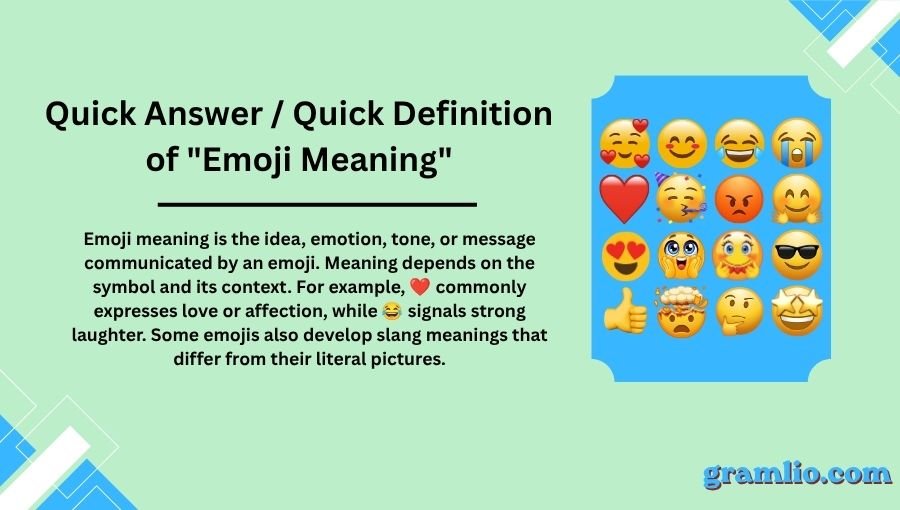
Emoji meaning is the idea, emotion, tone, or message communicated by an emoji. Meaning depends on the symbol and its context. For example, ❤️ commonly expresses love or affection, while 😂 signals strong laughter. Some emojis also develop slang meanings that differ from their literal pictures.
Also read: Bluebird Meaning in Bible
Detailed Meaning Breakdown
Primary Meaning
An emoji is a small digital symbol used to communicate an emotion, object, action, idea, or reaction.
The simplest way to understand emoji meaning is to start with the picture itself. 😀 suggests happiness because it shows a smiling face. 🎂 represents a birthday cake and is commonly used for birthdays.
I usually treat the literal picture as the starting point, not the final answer. Context often adds another layer.
Secondary Meanings
Many emojis have figurative or slang meanings.
Take 🔥. Literally, it’s fire. Online, however, someone might comment “🔥” under a song, outfit, or photo to mean excellent, exciting, attractive, or impressive.
Likewise, 💀 often means “I’m dying from laughter” among younger users. 👀 can signal curiosity, interest, suspicion, or “I’m watching this.”
These secondary meanings are why interpreting an emoji word-for-word can fail.
Rare or Misinterpreted Meanings
Some symbols are regularly mistaken for something else. 🙏 may represent prayer, thanks, hope, or a respectful request. Some people interpret it as a high five, although that isn’t its standard presentation.
Meanings can also become highly specific inside friend groups. My rule is simple: when an interpretation seems strange, check the conversation before assuming there’s a secret code.
What “Emoji Meaning” Means in Different Contexts
The same symbol can communicate different things depending on where and how it appears. Context is often more important than the image alone.
In Texting and Messaging
Texts lack facial expressions and voice tone, so emojis often supply that missing emotional information.
“Thanks!” sounds cheerful enough. “Thanks! 😊” can feel warmer and more personal. “Thanks. 👍” may simply confirm that the message was received, but in a tense exchange it can seem dismissive.
This is where emoji meaning becomes highly dependent on the words surrounding the symbol.
For example:
“Fine 😂” can suggest the sender finds the situation funny.
“Fine 🙄” may signal annoyance or disbelief.
One tiny image changes the whole mood.
On Social Media Platforms
Social platforms develop their own habits.
On Instagram, ❤️, 🔥, 😍, and ✨ often appear in captions, comments, Stories, and DMs to show admiration or excitement. A 🔥 comment under an outfit photo usually means the person thinks it looks great.
On TikTok, emojis frequently support jokes and internet slang. 💀 may mean something is extremely funny, while 😭 can express intense laughter, frustration, or emotion rather than literal crying.
On Snapchat, symbols in messages can feel casual, playful, or flirtatious. Hearts and smiling faces may take on extra weight when people message each other often.
On Threads, emoji use often resembles conversational social posting: quick reactions, humor, agreement, and irony.
I’ve noticed that reading the sentence before reading the emoji usually prevents the biggest mistakes.
In Dating and Relationships
Dating adds another layer because people look closely for signs of attraction.
A ❤️ from a partner usually feels natural. From a new match, it may signal growing affection. 😘 can suggest a kiss or flirtation, while 😏 may imply teasing, confidence, or sexual interest.
But no single symbol proves romantic intent.
For example, “Had fun tonight 😊” is warm but not necessarily romantic. “Can’t wait to see you again 😘❤️” sends a much stronger affectionate signal.
When reading emoji meaning in dating, look for a pattern of behavior, not one isolated heart.
In Professional Communication
Workplace emojis can make short messages feel more human.
“Great work! 👏” communicates praise. “Thank you 😊” can add warmth. A simple 👍 works well for quick acknowledgment in many team chats.
Still, professional communication needs restraint. Sexual, insulting, or highly suggestive symbols can create obvious problems. Even playful emojis may feel out of place in formal emails, legal discussions, complaints, or conversations with clients you don’t know well.
I tend to use emojis at work only when they make the intended tone clearer.
Cultural or Regional Differences
Emoji interpretation isn’t perfectly universal.
Gestures, colors, facial expressions, and symbols can have different associations across countries and communities. Age matters too. Younger users may understand 💀 as laughter immediately, while someone unfamiliar with that slang may read it literally.
Platform design can also alter how a face looks on different devices.
So when a message crosses cultures or generations, choose clear words rather than expecting an emoji to do all the work.
Tone, Psychology & Why People Use It
Why People Use It & What It Signals Socially
People use emojis because text can feel emotionally flat. A symbol can quickly show friendliness, humor, excitement, sympathy, approval, or playfulness.
Compare “Okay” with “Okay 😊.” The second can feel softer.
Emojis also create social connection. Friends may develop favorite symbols or private meanings. Communities build slang around them. In that sense, understanding emoji meaning involves understanding how people build shared social signals.
I often think of emojis as digital body language: useful, expressive, but never perfectly precise.
Emotional Layer Behind It
The emotional tone can change even when the basic message stays the same.
“Sure! 😊” feels friendly.
“Sure 👍” may feel neutral and efficient.
“Sure 🙄” sounds irritated or sarcastic.
“Sure 😏” can feel teasing or suggestive.
This doesn’t mean those readings are guaranteed. The relationship between the people matters. A close friend may use an expression jokingly that would sound rude from a stranger.
10 Real Conversation Examples (Explained)
1. “That presentation was amazing 🔥”
Intended meaning: The presentation was impressive. Tone: enthusiastic. The fire symbol strengthens the compliment.
2. “You actually said that? 💀”
Intended meaning: “That’s unbelievably funny.” Tone: amused and informal. It probably doesn’t refer to death.
3. “Drive safely ❤️”
Intended meaning: The sender cares about you. Tone: affectionate. In a relationship, it may carry romantic warmth.
4. “Got it 👍”
Intended meaning: Message received. Tone: usually neutral. During an argument, the same reply might seem abrupt.
5. “Oh, really? 👀”
Intended meaning: “Tell me more.” Tone: curious or playfully suspicious. The eyes suggest close attention.
6. “I’m so proud of you 😭”
Intended meaning: The sender feels deeply moved. Tone: emotional and positive. Tears aren’t always sadness.
7. “Another Monday 🙃”
Intended meaning: The sender isn’t thrilled about Monday. Tone: dry humor or mild frustration.
8. “Thanks for helping me 🙏”
Intended meaning: Sincere gratitude. Tone: appreciative and respectful. It can also suggest prayer in other settings.
9. “Nice photo 😏”
Intended meaning: Possibly teasing or flirtatious praise. Tone: suggestive. The relationship determines how strongly it’s read.
10. “Congratulations! 🎉”
Intended meaning: Celebration. Tone: upbeat and supportive. This is one of the easier symbols to interpret.
These examples show why emoji meaning can’t always be separated from the sentence around it.
Where Misunderstandings Happen
Context Confusion
The biggest problem is assuming one emoji always means one thing.
😭 can mean sadness, overwhelming happiness, or laughter. If someone writes “This video 😭,” the content of the video tells you which interpretation makes sense.
I wouldn’t assign a hidden meaning until I’ve checked the surrounding message.
Generational Gap
Emoji slang changes quickly.
Some younger users choose 💀 or 😭 for laughter where other people might use 😂. Meanwhile, an older sender may use 👍 simply as a friendly “okay,” even if a younger recipient reads the reply as cold.
Neither person necessarily intended offense. Their digital language habits differ.
Platform Differences
The same emoji may look slightly different across operating systems and apps. Social norms differ too.
A symbol common in TikTok jokes may seem strange in an office email. A heart in an Instagram comment can be casual admiration, while the same heart in a private dating message can feel more intimate.
Similar Words, Symbols, or Abbreviations
Emoji meaning often overlaps with internet slang, emoticons, and reaction symbols, but they aren’t identical.
| Term | Meaning | How It Differs from Emoji Meaning |
|---|---|---|
| Emoticon | Face made with keyboard characters, such as 🙂 | Uses typed characters instead of a graphical symbol |
| GIF | Short animated image | Shows movement and usually provides more visual context |
| Sticker | Decorative digital image | Often larger and more detailed than an emoji |
| LOL | Laughing out loud | States laughter through an abbreviation |
| LMAO | Strong expression of laughter | More explicit and informal than 😂 |
| ❤️ | Love, affection, support | A specific symbol whose meaning depends on context |
| 😂 | Strong laughter | More direct than many newer slang reactions |
| 💀 | Figurative “I’m dead” reaction | Often represents extreme laughter in online slang |
| 👀 | Attention, curiosity, interest | Can hint at interest without directly stating it |
When Not to Use “Emoji Meaning”
Understanding emoji meaning also helps you recognize situations where a symbol is better left out.
Professional Risks
Avoid ambiguous emojis in serious workplace discussions, formal applications, disciplinary matters, or legal communication.
For example, replying “We’ll discuss this later 😏” to an employee could create an unintended suggestive tone. Plain language is safer.
Cultural Risks
Don’t assume gestures and symbols have identical meanings everywhere.
If you’re communicating with an international audience, especially about serious topics, words provide more precision. I’ve found that clarity beats cleverness whenever cultural interpretation is uncertain.
Tone Risks
Skip emojis when they could make grief, conflict, criticism, or sensitive news seem less serious.
A smile after negative feedback can look sarcastic even when you’re trying to soften the message. If the emotional stakes are high, say exactly what you mean.
Expert Tips for Using “Emoji Meaning” Correctly
When you’re unsure about emoji meaning, a few practical habits make interpretation much easier:
- Read the full message first. Words usually provide the strongest clue.
- Consider your relationship with the sender before assuming romantic or hostile intent.
- Look at the conversation’s overall mood, not one isolated symbol.
- Remember that internet slang changes, especially among younger users.
- Don’t assume a heart automatically means romance.
- Use clear words for serious, professional, or sensitive messages.
- Watch for sarcasm, especially with 🙃, 😏, 🙄, and similar expressions.
- Consider cultural differences when messaging people from different backgrounds.
- If the meaning really matters, ask the sender rather than guessing.
Frequently Asked Questions
What does emoji meaning refer to?
It refers to the message, emotion, idea, or tone communicated by an emoji. Some symbols have obvious literal meanings, while others have slang or social meanings. The surrounding words, sender, relationship, and platform can all affect the final interpretation.
Can an emoji have more than one meaning?
Yes. Most popular emojis can communicate several ideas. 😭 might show sadness, joy, or intense laughter. 👀 may express curiosity, suspicion, or interest. Context usually tells you which interpretation fits the conversation.
Are emojis positive or negative?
Neither by default. Many emojis can be positive in one situation and negative in another. 🙂 may show polite friendliness, but it can sometimes feel restrained or sarcastic during a tense conversation. Read the entire exchange before judging its tone.
Can an emoji be romantic?
Absolutely. ❤️, 😘, 🥰, and 😍 often communicate romantic affection, but they aren’t automatic proof of attraction. Friends and family use hearts too. Repeated affectionate language and behavior provide stronger clues than a single symbol.
Why does 💀 mean laughing?
Online slang turned 💀 into a visual version of “I’m dead,” meaning something is so funny that the person is figuratively dying from laughter. It’s especially common in casual social media conversations and among younger users.
What does 😭 mean in texting?
😭 can represent genuine crying, deep emotion, frustration, overwhelming happiness, or intense laughter. “I miss you 😭” suggests sadness or emotion, while “That video is hilarious 😭” clearly points toward laughter.
Why do different generations use emojis differently?
Online language changes like spoken slang does. People who adopted emojis at different times developed different habits. One group may favor 😂 for laughter while another uses 💀. These differences can create misunderstandings even when both people have friendly intentions.
How should I respond if I don’t understand an emoji?
Start with the surrounding sentence and conversation. If the meaning affects something important, ask naturally: “What did you mean by that emoji?” That’s more reliable than assuming a symbol is romantic, rude, sarcastic, or secretive.
Final Summary & Smart Usage Advice
Understanding emoji meaning is less about memorizing a giant dictionary and more about learning to read context.
Start with the symbol’s common definition. Then look at the words around it, the sender’s personality, your relationship, the platform, and the mood of the conversation. That simple process solves most confusion.
Some symbols are straightforward. 🎉 usually signals celebration. Others are flexible. 💀 can mean laughter, 😭 can express several strong emotions, and ❤️ may communicate romance, friendship, family love, or support.
The safest approach is to avoid treating any single emoji as absolute proof of someone’s feelings. This matters most in dating, arguments, professional conversations, and cross-cultural communication.
Use emojis when they make your message warmer, clearer, or more expressive. Skip them when precision matters more than personality. And when an unfamiliar symbol could change how you understand an important message, asking the sender is perfectly reasonable.
You now have the tools to interpret both literal symbols and modern emoji slang without overthinking every face, heart, or reaction.
Final takeaway: Read the words, read the relationship, then read the emoji.

I’m Ethan Holloway, and I work at Gramlio. I’m an expert in grammar and focus on making confusing English rules easy to understand.