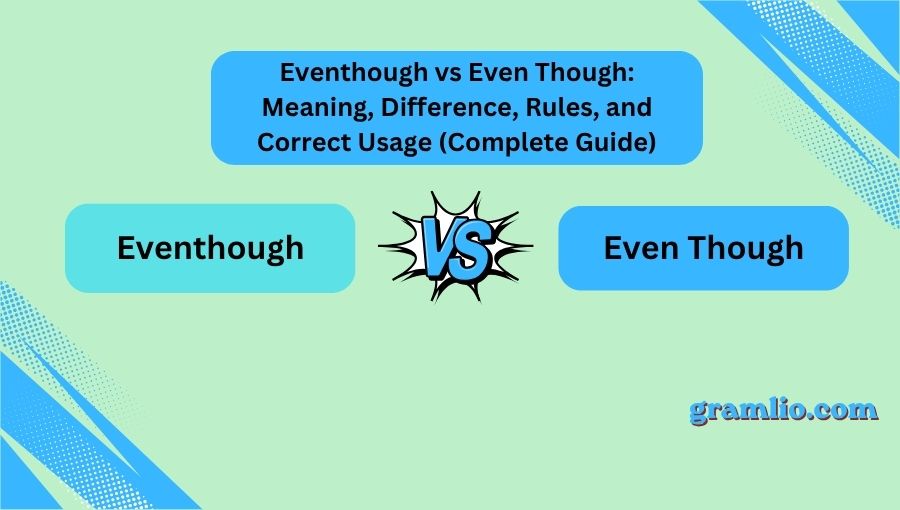
Eventhough vs Even Though: Meaning, Difference, Rules, and Correct Usage (Complete Guide)
Have you ever typed a sentence like “I went out eventhough it was raining” and felt unsure if it looked right? 🤔 You’re not alone. One of the most common spelling confusions in English is “Eventhough vs Even Though”. Many learners, writers, and even native speakers accidentally combine the words into “eventhough,” thinking it is correct because it sounds natural in fast speech.
However, English grammar has strict rules about this phrase, and understanding the difference is important for clear, professional, and accurate writing. Whether you’re writing emails, essays, social media posts, or business content, using the correct form can make a big difference in how your message is received.
In this detailed guide, we will break down everything you need to know about Eventhough vs Even Though, including meanings, grammar rules, examples, common mistakes, and practical usage in real life. By the end, you will never confuse these two again—and your writing will instantly look more polished and professional. ✍️
Quick Answer: Eventhough vs Even Though

The correct form is “even though” (two separate words). It is a subordinating conjunction used to introduce a contrast between two ideas.
❌ “eventhough” is incorrect and not recognized in standard English grammar or dictionaries.
✔ “even though” is correct and widely used in formal and informal writing.
👉 Example:
- ✔ Even though it was cold, she went for a walk.
- ❌ Eventhough it was cold, she went for a walk.
Understanding the Basics of Eventhough vs Even Though
To fully understand Eventhough vs Even Though, we need to look at what the correct phrase actually means.
What does “Even Though” mean?
“Even though” is a subordinating conjunction. It is used to show contrast or contradiction between two statements.
It means:
- Despite the fact that
- Although
- In spite of the fact that
Example:
- Even though he was tired, he finished his homework.
👉 This means:
He was tired, but he still finished his homework.
Why “Eventhough” is incorrect
“Eventhough” is a common spelling mistake caused by:
- Fast typing
- Auto-correct errors
- Mishearing spoken English
- Lack of grammar awareness
But grammatically:
- English does NOT combine “even” and “though” into one word.
- Dictionaries like Merriam-Webster and Oxford only recognize “even though” as two separate words.
Comparison Table: Eventhough vs Even Though
| Form | Type | Meaning | Example | Correct/Incorrect |
|---|---|---|---|---|
| eventhough | Incorrect spelling | No meaning in standard English | ❌ Eventhough it rained, we went out. | ❌ Incorrect |
| even though | Subordinating conjunction | Despite the fact that / although | ✔ Even though it rained, we went out. | ✔ Correct |
Correct Meaning & Usage of “Even Though”
1. Showing Contrast
“Even though” is mainly used to show unexpected contrast.
Example:
- Even though she studied hard, she didn’t pass the exam.
👉 Breakdown:
- Fact 1: She studied hard
- Fact 2: She did not pass
- Contrast: Unexpected result
2. Emphasizing Strong Opposition
It is stronger than “although.”
Example:
- Even though it was expensive, he bought the phone.
This shows a stronger emotional or logical contrast than just “although.”
3. Expressing Real-Life Situations
Example:
- Even though traffic was heavy, we arrived on time.
Test Tip 🧠
Ask yourself:
👉 “Is there a contrast between two ideas?”
If yes → Use even though
If no → You don’t need it.
Case Study: Real-Life Usage Example
Scenario: Workplace Email
❌ Incorrect:
Eventhough the report was delayed, we submitted it on time.
✔ Correct:
Even though the report was delayed, we submitted it on time.
Why it matters:
In professional communication, spelling errors like “eventhough” can:
- Reduce credibility
- Look unprofessional
- Affect client perception
Using correct grammar improves clarity and trust.
Grammar Rules Behind “Even Though”
1. It is a subordinating conjunction
This means it connects two clauses:
- Main clause
- Dependent clause
Structure:
👉 Even though + subject + verb, subject + verb
Example:
- Even though it was raining, we played outside.
2. It cannot be written as one word
According to standard grammar references:
- “Even” is an adverb
- “Though” is a conjunction
- They function separately in grammar
Therefore, combining them is grammatically incorrect.
3. Similar meaning words
You can sometimes replace it with:
- Although
- Though
- While
- Despite the fact that
But NOT “eventhough.”
Common Mistakes with Eventhough vs Even Though
Why people make this mistake
- Fast typing on mobile keyboards 📱
- Auto-correct suggestions
- Speaking influence (sounds like one word)
- Lack of grammar practice
Common Grammar Confusions Table
| Incorrect Form | Correct Form | Reason |
|---|---|---|
| eventhough | even though | Two words required in grammar |
| it’s | its | Apostrophe misuse |
| your | you’re | Confusion between possession and contraction |
| alot | a lot | “A lot” is always two words |
| didnt | didn’t | Missing apostrophe |
Usage in Different Contexts
1. Everyday Conversation 🗣️
- Even though I was busy, I called you.
2. Professional Writing 💼
- Even though the deadline was tight, the project was completed successfully.
3. Creative Writing ✍️
- Even though the night was dark, hope still shined in her heart.
4. Social Media 💬
- Even though it’s Monday, I’m still smiling 😊
Why It Matters
Correct usage of even though is important because:
✔ Clarity in Communication
Your meaning becomes easier to understand.
✔ Professionalism
Correct grammar improves credibility in writing.
✔ Digital Writing Accuracy
Online content is judged quickly—errors reduce trust.
“Good grammar is the foundation of clear communication.”
Special Exception
There are no accepted exceptions where “eventhough” is correct in standard English.
However:
- It may appear in informal texting or typo errors
- It should NEVER be used in academic or professional writing
Quick Recap Checklist
| Question | If Yes → Use |
|---|---|
| Do you want to show contrast? | Even though |
| Are you writing formal content? | Even though |
| Did you write “eventhough”? | Correct it immediately |
Practice Examples:
- Even though it was late, I stayed awake.
- Even though he apologized, she was still upset.
- Even though the weather was bad, we traveled.
FAQs: Eventhough vs Even Though
1. Is “eventhough” a correct word?
No. “Eventhough” is not correct in English grammar. The correct form is “even though.”
2. Why do people write “eventhough”?
Because of fast typing, auto-correct errors, and spoken language influence.
3. What is the meaning of “even though”?
It means “despite the fact that” and is used to show contrast.
4. Can I use “although” instead of “even though”?
Yes, both are correct, but “even though” is stronger in emphasis.
5. Is “even though” formal or informal?
It is used in both formal and informal writing.
6. How can I avoid this mistake?
Practice writing, use grammar tools, and remember it is always two words.
Conclusion
Understanding Eventhough vs Even Though is simple once you know the rule: the correct form is always “even though”, written as two separate words. The incorrect version “eventhough” is just a common spelling mistake with no grammatical validity.
This small detail can significantly improve your writing quality, whether you are writing emails, essays, or social media posts. By using the correct form, you ensure clarity, professionalism, and accuracy in communication.
So next time you feel tempted to type “eventhough,” pause for a second and remember—it’s always even though that wins the grammar game. ✨
Also Read This: Adapter vs Adaptor

I’m Adrian Bellmont, and I work at Gramlio. I’m an expert in grammar and enjoy breaking down complex language rules into simple ideas.