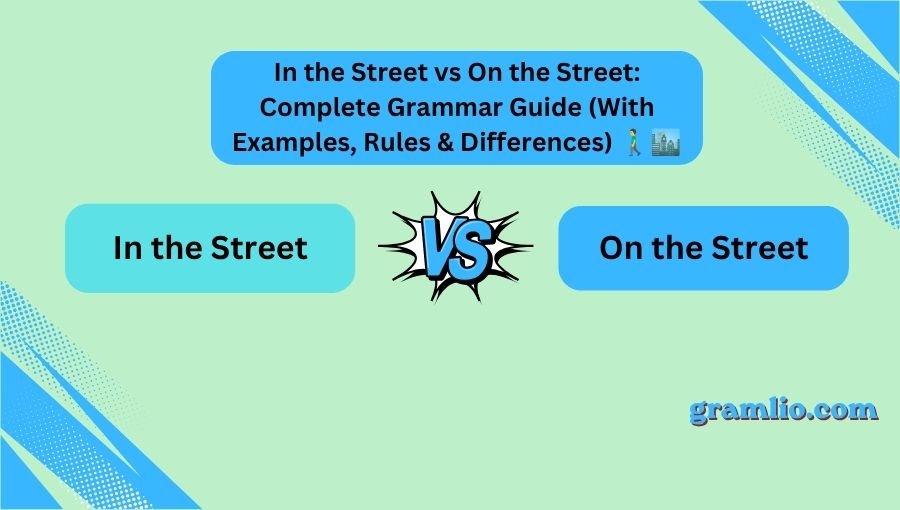
In the Street vs On the Street: Complete Grammar Guide (With Examples, Rules & Differences) 🚶♂️🏙️
Have you ever been confused about in the street vs on the street while speaking or writing English? 🤔 These two phrases look similar, but their usage can change the meaning of a sentence completely. Many English learners struggle with this small yet important grammar difference.
The confusion happens because English prepositions don’t always follow strict logic. Instead, they depend on context, regional usage, and meaning. While one phrase may describe being inside a roadway, the other often refers to a general location along a street or sidewalk.
In this article, we will break down in the street vs on the street in the simplest way possible. You’ll learn meanings, rules, examples, common mistakes, and real-life usage so you never mix them up again. By the end, you’ll feel confident using both expressions correctly in any situation. ✨
Quick Answer: In the Street vs On the Street

“In the street” usually refers to being physically inside the roadway or traffic area where vehicles move. It often suggests danger or direct involvement with the road.
“On the street” generally means being located along or beside the street, such as walking, living, or being present in a street area. It is the more commonly used and natural expression in modern English.
👉 In short:
- In the street = inside the road/traffic area 🚗
- On the street = along or at the street location 🚶♀️
Understanding the Basics: In the Street vs On the Street
To fully understand this difference, we need to look at how English uses prepositions of place.
1. Meaning of “In the Street”
“In the street” is used when someone or something is physically within the roadway where vehicles move.
It often suggests:
- Standing inside traffic lanes
- Children playing on the road (dangerous context)
- Objects placed directly in the road
Examples:
- The ball rolled in the street and almost hit a car. ⚽🚗
- Children should not play in the street.
- A man was standing in the street, blocking traffic.
👉 This phrase is less common in everyday modern speech.
2. Meaning of “On the Street”
“On the street” is more flexible and widely used. It refers to being located along or beside a street.
It can mean:
- Walking on sidewalks or roadsides
- Being homeless (idiomatic use)
- General street location
Examples:
- She was walking on the street when it started raining. 🌧️
- Many people live on the street in big cities.
- The shop is on the street corner.
👉 This is the most natural and commonly used form in English today.
Comparison Table: In the Street vs On the Street
| Form | Type | Meaning | Example Sentence | Correct/Incorrect |
|---|---|---|---|---|
| In the street | Prepositional phrase | Inside the road/traffic area | The dog ran in the street and scared drivers. | Correct (contextual) |
| On the street | Prepositional phrase | Along/beside the street or location | He was walking on the street. | Correct |
| In the street | General usage | Less common, often implies danger | Children are playing in the street. | Correct but limited |
| On the street | General usage | Natural modern English usage | The cafe is on the street. | Correct |
Correct Meanings & Uses
H3: “In the Street” – When to Use It
Use “in the street” when you want to emphasize being inside the road space.
Example 1:
- The accident happened in the street.
👉 Meaning: The event occurred in the traffic lane.
Example 2:
- A man fell asleep in the street.
👉 Meaning: He was lying directly on the road.
💡 Test Tip:
If replacing “street” with “road” still makes sense, “in the street” might be acceptable.
H3: “On the Street” – When to Use It
Use “on the street” for general location or movement.
Example 1:
- There are many shops on the street.
👉 Meaning: Shops are located along the street.
Example 2:
- She met her friend on the street.
👉 Meaning: They met while outside, near or on the street area.
💡 Test Tip:
If you can replace it with “outside in the city,” then “on the street” is correct.
Case Study Section 📘
Real-Life Example: Workplace Conversation
Situation: A delivery company discussion
Manager: “Where was the package left?”
Employee: “It was dropped on the street near the client’s house.”
Later, the manager clarifies:
“Make sure it is not left in the street, where vehicles can damage it.”
👉 Explanation:
- “On the street” = general placement
- “In the street” = unsafe, direct road placement
This shows how small preposition changes can completely alter meaning in professional communication.
Grammar Rules Explanation 📚
According to standard grammar references such as Merriam-Webster and other English usage guides:
- “On” is used for surfaces or linear areas (like roads, streets, walls).
- “In” is used for enclosed or bounded spaces.
Why “On the Street” is More Common:
A street is viewed as a surface or path, not an enclosed space. That’s why native speakers prefer:
- ✔ On the street
- ✖ In the street (less natural)
Why “In the Street” Still Exists:
It is used when emphasizing:
- Danger
- Direct road position
- Physical placement inside traffic lanes
Common Mistakes ⚠️
Why People Get Confused
People often mix these phrases due to:
- Fast typing ⌨️
- Autocorrect errors 📱
- Learning English as a second language 📖
- Regional variations in English usage 🌍
Similar Grammar Confusions Table
| Incorrect / Confusing Pair | Correct Usage | Reason |
|---|---|---|
| in the street / on the street | on the street | “street” is treated as a surface |
| in the road / on the road | on the road | roads are surfaces |
| in the bus / on the bus | on the bus | buses are treated as surfaces inside transport |
| in the car / in the car | in the car | cars are enclosed spaces |
Usage in Different Contexts
1. Everyday Conversation 🗣️
- I saw him on the street yesterday.
2. Professional Writing 💼
- The incident occurred in the street, causing traffic disruption.
3. Creative Writing ✍️
- She stood on the street, watching the city lights fade.
4. Social Media/Texting 📱
- Met my old friend on the street today!
Why It Matters 🎯
Using correct prepositions improves:
- Communication clarity 🧠
- Professional credibility 💼
- Writing accuracy ✍️
- Reader understanding 📖
“Small grammar choices create big communication differences.”
Even a small error like “in the street” vs “on the street” can change how natural your English sounds.
Special Exception ⚡
In some dialects or older British English usage, “in the street” may appear more frequently in literature or older texts. However, modern American English strongly prefers “on the street.”
No brand-specific or technical exceptions apply here.
Quick Recap Checklist ✔️
| Question | If Yes → Use |
|---|---|
| Is it about general location? | On the street |
| Is it about traffic/road danger? | In the street |
| Is it professional writing? | On the street |
| Is it describing movement or walking? | On the street |
Practice Examples:
- The kids are playing ___ the street.
- I saw a car parked ___ the street.
- There was an accident ___ the street.
Answers:
- in
- on
- in
FAQs (Frequently Asked Questions) ❓
1. Which is correct: in the street or on the street?
Both are correct, but “on the street” is more commonly used in modern English.
2. Can I use “in the street” in writing?
Yes, but only when referring to being inside the road or traffic area.
3. Is “on the street” American or British English?
It is used in both, but it is especially common in American English.
4. Does “on the street” mean homeless?
Yes, in informal usage, it can mean someone living without a home.
5. Why do we say “on the street” instead of “in the street”?
Because streets are considered flat surfaces, and “on” is used for surfaces.
6. What is the safest option to use?
In most cases, “on the street” is the safest and most natural choice.
Conclusion
Understanding the difference between in the street vs on the street helps you speak and write English more naturally and confidently. While both phrases exist, they are not interchangeable in all contexts.
- Use “on the street” for general, everyday communication.
- Use “in the street” only when emphasizing direct placement inside the road or traffic area.
Mastering small grammar details like this improves your fluency, clarity, and professionalism. 🌟
So next time you describe a location, choose wisely—because sometimes, one small preposition can change the entire meaning of your sentence.
Also Read This: Reevaluation or Re-evaluation

I’m Caleb Whitmore, and I work at Gramlio. I’m an expert in grammar and help readers understand English with simple explanations and real-life examples.