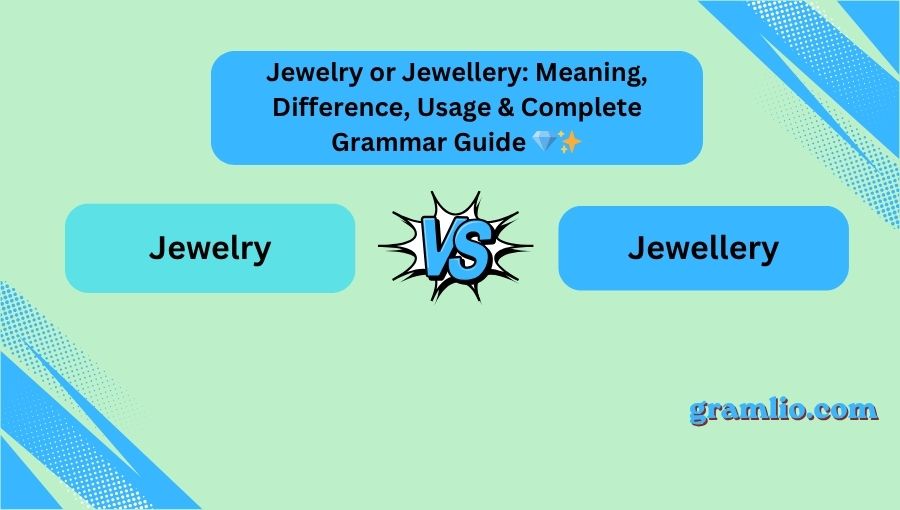
Jewelry or Jewellery: Meaning, Difference, Usage & Complete Grammar Guide 💎✨
Jewelry or Jewellery is one of the most common spelling confusions in English writing today. Have you ever noticed that some people write “jewelry” while others write “jewellery” and wondered which one is actually correct? 🤔 You’re not alone. This small difference often confuses learners, bloggers, and even professional writers.
The truth is, both jewelry and jewellery are correct—but they are used in different parts of the world. This spelling variation often creates confusion in SEO writing, academic work, and everyday communication. Many people assume one is wrong, but in reality, it is simply a difference between American English and British English.
In this complete guide, we will break down everything you need to know about jewelry or jewellery, including meaning, usage, grammar rules, real-life examples, common mistakes, and practical tips. By the end, you will clearly understand when to use each form and how to avoid errors in writing. 💡
Whether you are a student, content writer, or business owner, mastering this small detail can make your writing more professional and accurate.
Quick Answer: Jewelry or Jewellery

Jewelry (US English) and Jewellery (UK English) both mean decorative items worn for personal adornment, such as rings, necklaces, bracelets, and earrings. 💍
The only difference is spelling based on region:
- Jewelry → Used in American English
- Jewellery → Used in British English, Canadian English, and others
Both are grammatically correct and interchangeable depending on your audience.
Understanding the Basics: Jewelry or Jewellery
To understand this topic clearly, let’s break it down into simple parts.
The word refers to ornamental items made from metals, gemstones, or other materials that people wear for decoration or cultural significance.
📊 Comparison Table: Jewelry vs Jewellery
| Feature | Jewelry (US) | Jewellery (UK) |
|---|---|---|
| Form | American English | British English |
| Type | Noun | Noun |
| Meaning | Decorative items | Decorative items |
| Example | She bought jewelry | She bought jewellery |
| Correct Usage | USA audience | UK/Commonwealth audience |
👉 Key Insight: There is no difference in meaning—only spelling and regional preference.
Correct Meanings & Uses
💎 What Does Jewelry/Jewellery Mean?
Both terms refer to:
- Rings 💍
- Necklaces 📿
- Earrings 👂
- Bracelets 🪶
- Brooches and ornaments
These items are typically worn for:
- Fashion
- Cultural traditions
- Religious significance
- Personal expression
📝 Example Sentences (US English – Jewelry)
- She bought beautiful jewelry for her wedding.
- Gold jewelry is very popular in the United States.
- He designs custom jewelry for clients.
📝 Example Sentences (UK English – Jewellery)
- She inherited antique jewellery from her grandmother.
- The shop sells handmade jewellery.
- Silver jewellery is trending in London.
🧠 Test Tip
If your audience is:
- 🇺🇸 American → Use Jewelry
- 🇬🇧 British/International → Use Jewellery
👉 Quick trick:
“US = shorter spelling (jewelry)”
“UK = longer spelling (jewellery)”
Case Study Section: Real-Life Usage
💼 Example: Online Jewelry Business
Imagine you are writing product descriptions for an online store.
- If your target audience is in the United States, you write:
“Explore our premium gold jewelry collection designed for modern elegance.”
- If your audience is in the UK:
“Explore our premium gold jewellery collection designed for modern elegance.”
📌 Why This Matters
A brand that uses the wrong spelling may:
- Confuse customers
- Reduce trust
- Affect SEO rankings in specific regions
👉 Proper spelling improves professionalism and audience targeting.
Grammar Rules Explanation
According to standard English references like Merriam-Webster, both spellings are valid nouns referring to personal ornaments.
🧾 Rule Summary:
- “Jewelry” → Preferred in American English
- “Jewellery” → Preferred in British English
❗ Why Are They Different?
The difference comes from historical language evolution:
- American English simplified many British spellings
- British English retained older French-influenced forms
The word originally comes from the Old French term “jouel” meaning ornament.
Common Mistakes
Many learners mix up or misuse these terms. Let’s explore why.
❌ Common Errors:
- Writing “jewelry” in British academic writing
- Using “jewellery” for American SEO content
- Mixing both spellings in the same document
🧠 Why These Mistakes Happen:
- Fast typing ⌨️
- Autocorrect issues 📱
- Lack of awareness of regional spelling differences
📊 Table: Similar Grammar Confusions
| Incorrect | Correct | Reason |
|---|---|---|
| color / colour | color (US), colour (UK) | regional spelling |
| center / centre | center (US), centre (UK) | regional spelling |
| jewelry / jewellery | jewelry (US), jewellery (UK) | spelling variation |
| organize / organise | organize (US), organise (UK) | regional rule |
Usage in Different Contexts
🗣️ Everyday Conversation
- “I love your jewelry!” (US)
- “Your jewellery looks stunning!” (UK)
💼 Professional Writing
- Product descriptions
- Fashion blogs
- E-commerce listings
👉 Consistency is key for branding.
✍️ Creative Writing
Writers may choose spelling based on character location:
- American character → jewelry
- British character → jewellery
📱 Social Media & Texting
On platforms like Instagram or TikTok:
- #jewelry (global + US audience)
- #jewellery (UK audience)
Why It Matters (Important)
Using the correct spelling improves:
- Communication clarity 📢
- SEO performance 📈
- Professional writing quality 🧾
- Audience trust 🤝
“Good writing is clear thinking made visible.”
A small spelling choice can significantly impact how your content is perceived online.
Special Exception
There are no true exceptions to the spelling rule. However:
- Brand names may use either spelling intentionally
Example: “Jewelry Boutique” vs “Jewellery House” - SEO strategy may require dual usage in global content
👉 Always follow your target audience, not personal preference.
Quick Recap Checklist
| Question | If Yes → Use |
|---|---|
| Writing for US audience? | Jewelry |
| Writing for UK audience? | Jewellery |
| Need SEO targeting? | Match region |
| Writing global content? | Choose one consistently |
🧪 Practice Examples
- She designs handmade ______ for luxury clients.
- The store sells gold ______ in London.
- My mother loves antique ______ pieces.
Answers:
- jewelry (US)
- jewellery (UK)
- jewelry/jewellery (depends on region)
FAQs (Frequently Asked Questions)
1. What is the difference between jewelry and jewellery?
There is no meaning difference. Only spelling differs based on US and UK English.
2. Which spelling is correct, jewelry or jewellery?
Both are correct. “Jewelry” is American English, while “jewellery” is British English.
3. Why does America use jewelry instead of jewellery?
American English simplified British spellings over time to create a more standardized system.
4. Can I use both spellings in one article?
No. It is best to stay consistent and choose one based on your target audience.
5. Is jewelry singular or plural?
“Jewelry/jewellery” is an uncountable noun, so it does not have a plural form.
6. What is the origin of the word jewelry?
It comes from the Old French word “jouel”, meaning ornament or treasure.
Conclusion
Understanding the difference between jewelry or jewellery is simple once you know the rule: both words mean the same thing, but the spelling changes depending on regional English usage. 💎
If you are writing for an American audience, always use “jewelry”. If your readers are from the UK or Commonwealth countries, “jewellery” is the correct choice. This small detail plays a big role in professional writing, branding, and SEO performance.
By using the correct spelling consistently, you improve clarity, avoid confusion, and enhance your credibility as a writer. Whether you are creating blog posts, product descriptions, or academic content, this rule will always help you maintain accuracy.
In the end, it’s not about which spelling is right or wrong—it’s about knowing your audience and writing with precision. ✨
Master this small difference, and your English writing instantly becomes more polished and professional.
Also Read This: Lath vs Lathe

I’m Lucas Wrenford, and I work at Gramlio. I’m an expert in grammar and share clear tips to improve writing and communication skills.