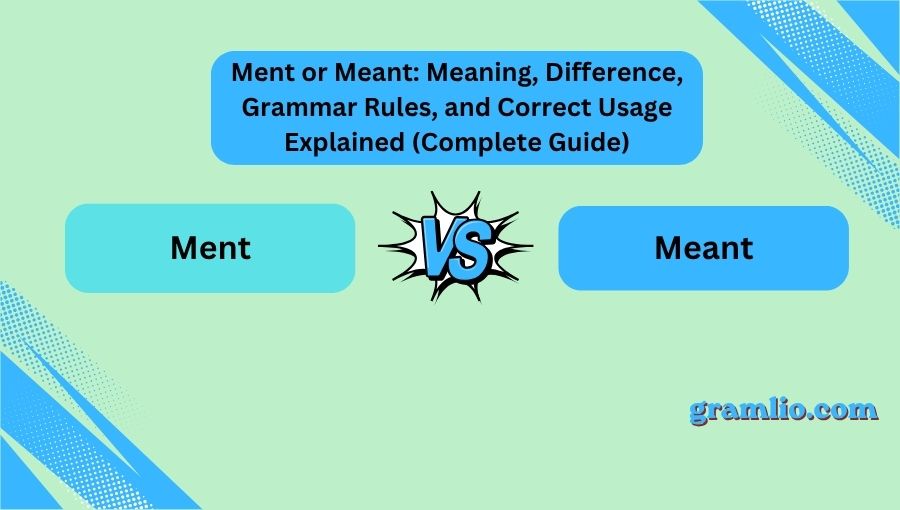
Ment or Meant: Meaning, Difference, Grammar Rules, and Correct Usage Explained (Complete Guide)
Quick Answer: Ment or Meant Meaning

The correct word is “meant”, which is the past tense and past participle of mean. It is used to describe intention or something that was intended or signified in the past.
The term “ment” is not a standalone English word in this context. It is often a typing error, a truncated word, or part of other words like comment, moment, or segment.
👉 Example:
- Correct: I meant to call you yesterday.
- Incorrect: I ment to call you yesterday.
Understanding the Basics of Ment or Meant
To fully understand ment or meant, we need to break down how English forms words and how verb tenses work.
What is “Meant”?
“Meant” is the past tense of the verb “mean.”
It is used when:
- Talking about intention in the past
- Explaining something that had significance
- Referring to something planned or intended
Examples of “Meant”
- I meant no harm.
- She meant what she said.
- They meant to arrive earlier.
What is “Ment”?
“Ment” is not a standalone verb or correct word in standard English grammar.
However, it appears in:
- Words like comment
- Words like segment
- Words like moment
But by itself, “ment” has no meaning in this context.
Comparison Table: Ment vs Meant
| Form | Type | Meaning | Example Sentence | Correct/Incorrect |
|---|---|---|---|---|
| Meant | Verb (past tense) | Intended or signified in past | I meant to reply earlier. | ✅ Correct |
| Ment | Fragment/typo | No meaning alone | I ment to reply earlier. | ❌ Incorrect |
Correct Meanings & Uses of “Meant”
1. Expressing Intention
This is the most common use of “meant.”
👉 Example:
- I meant to send you the file yesterday.
✔ Meaning: The action was planned but did not happen.
2. Expressing Significance
“Meant” can describe importance or meaning.
👉 Example:
- This gift meant a lot to me.
✔ Meaning: The gift had emotional value.
3. Clarifying Misunderstandings
Used when explaining what you intended to say.
👉 Example:
- I meant it as a joke, not an insult.
✔ Meaning: Clarification of intent.
Test Tip 🧠
If you can replace the word with “intended” or “was supposed to,” then “meant” is correct.
Example:
- I intended to call you → I meant to call you ✔
Case Study: Real-Life Usage Example
Scenario: Workplace Email
Subject: Apology for Missed Meeting
Email:
Hi Team,
I sincerely apologize for missing the meeting yesterday. I meant to join, but an urgent issue came up at work. I understand the importance of the discussion and will review the notes shared.
Analysis:
- “Meant” clearly shows intention.
- Using “ment” would make the email look unprofessional and incorrect.
- Proper usage maintains credibility and clarity.
Grammar Rules Behind “Meant vs Ment”
Rule 1: “Mean” is an irregular verb
The verb mean changes forms like this:
- Present: mean
- Past: meant
- Past participle: meant
This is confirmed by standard dictionaries like Merriam-Webster and Oxford English Dictionary.
Rule 2: “Ment” is not a valid verb form
English verbs do not form past tense by just adding “-t” or “-nt” randomly. So “ment” is not grammatically valid.
Rule 3: Context determines correctness
If the sentence refers to:
- intention → use meant
- meaning in past → use meant
Common Mistakes
Why People Confuse Ment and Meant
- Fast typing on mobile keyboards ⌨️
- Autocorrect errors
- Mishearing pronunciation
- Lack of grammar awareness
Similar Confusing Word Table
| Confusion Pair | Correct Form | Incorrect Form | Reason for Error |
|---|---|---|---|
| you’re/your | you’re | your | pronunciation similarity |
| it’s/its | it’s | its | apostrophe confusion |
| meant/ment | meant | ment | typing shortcut |
| there/their | their | there | sound similarity |
Usage in Different Contexts
1. Everyday Conversation
- I meant to text you back.
2. Professional Writing
- We meant to submit the report before Friday.
3. Creative Writing
- The silence in the room meant something darker was coming.
4. Social Media / Texting
- I meant to post this yesterday 😅
Why It Matters (Important)
Correct usage of ment or meant matters because language shapes perception. A small error can affect how others view your communication skills.
Key Reasons:
- Improves clarity in communication
- Enhances professional image
- Avoids misunderstandings
- Strengthens writing confidence
“Clear writing is clear thinking made visible.”
In professional environments, accuracy is not optional—it is expected.
Special Exception
There is no exception where “ment” is used as a standalone correct word in standard English grammar.
However:
- “-ment” is a suffix, not a word
- It forms nouns like enjoyment, achievement, development
So remember:
- ❌ ment (alone) = incorrect
- ✔ -ment (suffix) = correct in word formation
Quick Recap Checklist
| Question | If Yes → Use |
|---|---|
| Are you talking about past intention? | Use meant |
| Can it be replaced with “intended”? | Use meant |
| Is “ment” standing alone? | Do NOT use it |
Practice Examples:
- I ___ to help you. → meant
- She ___ everything she said. → meant
- He ___ to arrive early. → meant
FAQs: Ment or Meant
1. Is “ment” a real English word?
No, “ment” is not a standalone English word. It usually appears as part of other words or as a typing error.
2. What is the correct spelling: ment or meant?
The correct spelling is “meant.”
3. What does “meant” mean in simple English?
It means something was intended, planned, or had meaning in the past.
4. Why do people write “ment” instead of “meant”?
Most often due to fast typing, autocorrect issues, or spelling mistakes.
5. Is “meant” past tense of “mean”?
Yes, “meant” is the correct past tense and past participle of “mean.”
6. Can “ment” ever be correct in grammar?
Only as part of other words (like comment or development), not alone.
Conclusion (Ment or Meant Explained Clearly)
The confusion between ment or meant is common, but the rule is simple and clear. The correct word is “meant,” which is the past tense of “mean” and is used to describe intention or significance in the past. The form “ment” does not exist as a standalone word in English grammar and is usually a typing or spelling error.
By understanding verb forms and practicing correct usage, you can avoid this mistake easily. Whether you are writing emails, messages, or essays, using “meant” correctly improves clarity and professionalism.
In the end, precision in language is not just about grammar—it’s about communication that builds trust and understanding. Every correct word strengthens your message, and “meant” is one of those small but powerful details that make your writing truly effective.
Also Read This: Appreciative of vs Appreciative for

I’m Adrian Bellmont, and I work at Gramlio. I’m an expert in grammar and enjoy breaking down complex language rules into simple ideas.