Work Experience vs Working Experience: Which One Is Correct? 📚
Have you ever written a resume, filled out a job application, or prepared for an interview and wondered about work experience vs working experience? 🤔 You are not alone.
Many English learners and even native speakers occasionally get confused by these two expressions. They look similar, and both seem related to jobs and employment. Because of this similarity, people often use them interchangeably. However, there is an important difference in how these terms are used in standard English.
Understanding the distinction between work experience vs working experience can improve your writing, make your resume sound more professional, and help you communicate clearly in academic and workplace settings.
In modern business English, one phrase is widely accepted and commonly used, while the other is often considered nonstandard or awkward in many contexts. Knowing which one to choose can make a significant difference when applying for jobs or writing professional documents.
This guide explains everything you need to know about work experience vs working experience, including meanings, grammar rules, examples, common mistakes, practical usage, and expert tips.
Quick Answer: Work Experience vs Working Experience
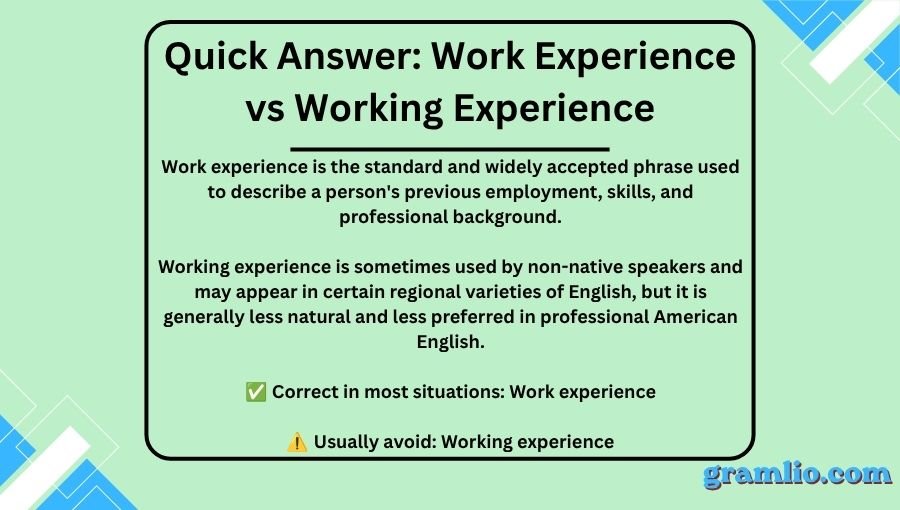
Work experience is the standard and widely accepted phrase used to describe a person’s previous employment, skills, and professional background.
Working experience is sometimes used by non-native speakers and may appear in certain regional varieties of English, but it is generally less natural and less preferred in professional American English.
✅ Correct in most situations: Work experience
⚠️ Usually avoid: Working experience
Understanding the Basics: Work Experience vs Working Experience
The confusion comes from the fact that both phrases involve the words work and experience. However, standard English treats them differently.
Comparison Table
| Form | Type | Meaning | Example | Correct/Incorrect |
|---|---|---|---|---|
| Work Experience | Noun phrase | Experience gained from employment or work activities | I have five years of work experience. | ✅ Correct |
| Working Experience | Less common phrase | Experience while working; often sounds unnatural in US English | I have five years of working experience. | ⚠️ Usually avoided |
| Work Experience Program | Fixed expression | Educational or career training placement | Students completed a work experience program. | ✅ Correct |
| Professional Work Experience | Formal phrase | Employment-related experience | Relevant professional work experience required. | ✅ Correct |
Core Difference
The phrase work experience has become a fixed expression in English.
When employers ask about your background, they typically ask:
- What is your work experience?
- Do you have relevant work experience?
- Describe your previous work experience.
Using working experience in these situations often sounds unnatural to native American English speakers.
Correct Meanings and Uses
What Does “Work Experience” Mean?
Work experience refers to the knowledge, skills, and expertise someone gains through employment, internships, volunteering, apprenticeships, or professional activities.
Examples
✅ I have three years of work experience in marketing.
Breakdown:
- I = subject
- have = verb
- three years = amount of time
- work experience = professional background
✅ Her work experience helped her get the promotion.
Breakdown:
- Her previous jobs developed valuable skills.
- Those skills contributed to her promotion.
✅ The company requires prior work experience.
Breakdown:
- Candidates should have employment history before applying.
Test Tip 🎯
Replace the phrase with job history.
If the sentence still makes sense, work experience is probably correct.
Example:
- I have five years of work experience.
- I have five years of job history.
Both sound natural.
What Does “Working Experience” Mean?
Technically, working experience could mean the experience of actively working. However, native speakers rarely use it this way.
Examples
⚠️ I have five years of working experience.
While many people understand this sentence, native speakers usually prefer:
✅ I have five years of work experience.
Why It Sounds Odd
The word working emphasizes the action of performing work rather than the accumulated professional background.
Because English already has the established phrase work experience, adding -ing often feels unnecessary.
Test Tip 🎯
If you are talking about qualifications on a resume, use work experience.
Case Study Section
Resume Example
Imagine Sarah is applying for a project management position.
Version A
I have seven years of working experience in project management.
This sentence is understandable but sounds less natural.
Version B
I have seven years of work experience in project management.
This sentence sounds professional, polished, and standard.
Employer Perspective
Recruiters read thousands of resumes.
Using standard business English can:
- Improve readability
- Demonstrate language proficiency
- Create a stronger professional impression
Therefore, Version B is the preferred choice.
Workplace Conversation Example
Employee
“I have extensive work experience in customer service.”
Manager
“Great. Tell me more about your experience handling clients.”
The phrase sounds natural and professional.
Grammar Rules Explanation
Understanding the grammar behind these expressions helps explain why one is preferred.
Why “Work Experience” Is Correct
In English, many noun phrases are formed by placing one noun before another noun.
Examples:
| Modifier Noun | Main Noun | Expression |
|---|---|---|
| Work | Experience | Work Experience |
| School | Bus | School Bus |
| Coffee | Cup | Coffee Cup |
| Computer | Program | Computer Program |
In these examples, the first noun describes the second noun.
Therefore:
- Work + Experience
- Experience related to work
This structure is grammatically standard.
Why “Working Experience” Is Less Common
The word working is a present participle.
Present participles often describe ongoing actions.
Examples:
- Running water
- Sleeping baby
- Working machine
When attached to experience, the phrase becomes less direct and less conventional.
That is why standard dictionaries and professional style guides overwhelmingly favor work experience.
According to definitions commonly reflected in major dictionaries such as Merriam-Webster, employment-related background is typically described as work experience, not working experience.
Common Mistakes
People often misuse these expressions because they seem logically similar.
Why Mistakes Happen
Fast Typing ⌨️
Writers sometimes add “-ing” automatically without considering standard usage.
Autocorrect 📱
Certain devices may not flag “working experience” because the phrase is technically understandable.
Lack of Knowledge 📖
Many English learners assume adding “-ing” creates a more natural phrase.
Translation Influence 🌍
Direct translation from another language often leads to “working experience.”
Similar Grammar Confusions
| Incorrect Choice | Correct Choice | Reason |
|---|---|---|
| Working Experience | Work Experience | Standard expression |
| Its | It’s | Different meanings |
| Your | You’re | Possessive vs contraction |
| Then | Than | Time vs comparison |
| Affect | Effect | Verb vs noun |
| Loose | Lose | Different meanings |
| Principal | Principle | Person vs rule |
Usage in Different Contexts
Everyday Conversation
When discussing jobs with friends or family:
✅ I have a lot of work experience in retail.
✅ She gained valuable work experience during college.
These sound natural.
Professional Writing
Resumes, cover letters, and applications should almost always use work experience.
Resume Example
Work Experience
- Sales Associate
- Marketing Coordinator
- Project Manager
Notice that resume sections are commonly labeled:
✅ Work Experience
❌ Working Experience
Creative Writing
Authors may occasionally use either phrase depending on character voice.
Example:
His years of work experience taught him patience.
This sounds natural and professional.
Social Media and Texting
On professional platforms, use:
✅ Looking for candidates with customer service work experience.
On casual platforms, people may write:
⚠️ I have lots of working experience.
While understandable, it is still less standard.
Why It Matters
Understanding work experience vs working experience is more important than many people realize.
Clarity in Communication
Readers immediately understand work experience because it is a standard phrase.
Clear communication reduces misunderstandings.
Professionalism
Employers expect professional language.
Using accepted terminology demonstrates attention to detail.
Writing Accuracy
Accurate language improves:
- Resumes
- Job applications
- LinkedIn profiles
- Academic writing
- Business communication
Digital Communication
Search engines, applicant tracking systems, and professional databases frequently use the phrase work experience.
Using the standard term improves consistency.
Quote 💡
“Clear language creates clear opportunities.”
This principle applies strongly to career-related communication.
Special Exception
There are a few situations where working experience may appear.
Regional English Variations
Some countries and regions use working experience more frequently in everyday speech.
Even so, international business English generally favors:
✅ Work experience
Context Describing the Experience of Working
Occasionally, a writer may intentionally describe someone’s experience while performing work.
Example:
His working experience during the crisis changed his perspective.
Although possible, many editors would still revise this to:
His work experience during the crisis changed his perspective.
Therefore, the standard form remains the safer choice.
Quick Recap Checklist
Which Form Should You Use?
| Question | If Yes → Use |
|---|---|
| Are you talking about job history? | Work Experience |
| Are you writing a resume? | Work Experience |
| Are you filling out an application? | Work Experience |
| Are you discussing professional qualifications? | Work Experience |
| Do you want standard US English? | Work Experience |
Practice Examples
Example 1
I have ten years of _____ in accounting.
✅ Work experience
Example 2
The employer requested previous _____.
✅ Work experience
Example 3
Her _____ helped her secure the position.
✅ Work experience
FAQs About Work Experience vs Working Experience
Is “working experience” grammatically correct?
It is not necessarily grammatically wrong, but it is less natural and less common in standard American English. Most professional writers prefer work experience.
Which phrase should I use on my resume?
Always use work experience. It is the accepted professional term used by employers and recruiters.
Why do some people say “working experience”?
This often happens because of regional language habits, translation influences, or misunderstandings about English grammar.
Is “work experience” one word or two?
It is usually written as two words: work experience.
Can native speakers understand “working experience”?
Yes. Most native speakers understand it. However, it may sound awkward or nonstandard compared to work experience.
What is the best phrase for job applications?
The best and most professional choice is work experience.
Final Comparison Table
| Feature | Work Experience | Working Experience |
|---|---|---|
| Common in US English | Yes | Rare |
| Preferred on resumes | Yes | No |
| Professional sounding | Yes | Less so |
| Widely accepted | Yes | Limited |
| Recommended usage | Yes | Usually avoid |
Conclusion
The debate over work experience vs working experience is actually quite simple once you understand the grammar and standard usage. In modern American English, work experience is the preferred and widely accepted term for describing a person’s employment background, professional skills, and career history. It appears in resumes, job applications, business documents, educational programs, and everyday professional communication.
While working experience may occasionally appear in certain regions or among English learners, it is generally considered less natural and less professional. Choosing work experience helps ensure clarity, accuracy, and credibility in your writing.
Whenever you are talking about qualifications, employment history, or career achievements, remember the rule:
✅ Use “work experience.”
⚠️ Avoid “working experience” unless a very specific context requires it.
Mastering small grammar distinctions like this can make your English sound more confident, polished, and professional every time you write. 🚀
Also Read This: Indolence vs Insolence

I’m Lucas Wrenford, and I work at Gramlio. I’m an expert in grammar and share clear tips to improve writing and communication skills.