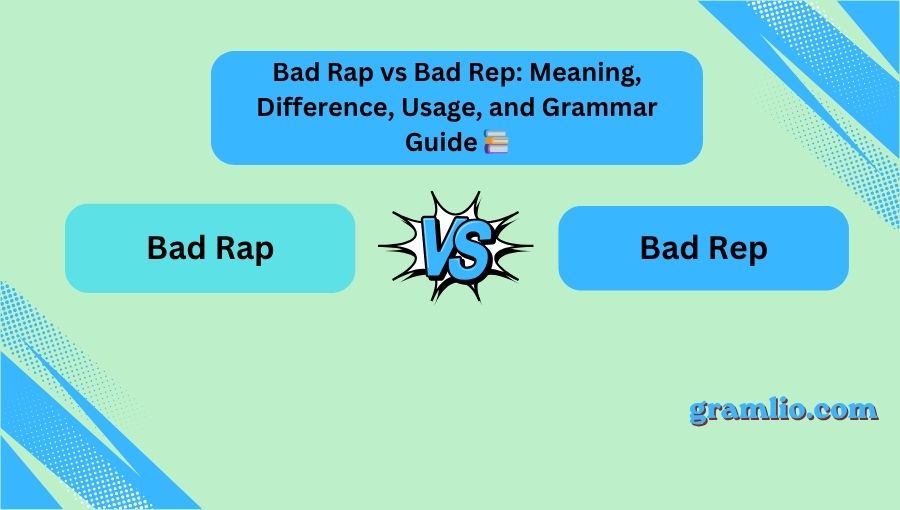
Bad Rap vs Bad Rep: Meaning, Difference, Usage, and Grammar Guide 📚
Have you ever heard someone say, “He’s getting a bad rap” and wondered if they meant “bad rep” instead? You are not alone. The confusion between Bad Rap vs Bad Rep is one of the most common English language mix-ups, especially in spoken conversation and informal writing. Both phrases sound almost identical, but they do not mean the same thing—and only one is technically correct in standard English grammar.
This confusion usually happens because English is full of homophones (words that sound the same but have different meanings and spellings). As a result, people often assume “rap” and “rep” are interchangeable. However, they come from completely different origins. One relates to reputation, while the other comes from a legal and conversational expression.
In this article, you will learn the true meaning of Bad Rap vs Bad Rep, how to use each correctly, why people confuse them, and how to avoid making this common mistake in writing and speech. Let’s break it down in a simple, clear, and practical way so you never get confused again. 😊
Quick Answer: Bad Rap vs Bad Rep

Bad rap is the correct and standard phrase in English. It means someone is being criticized unfairly or receiving negative judgment they may not deserve.
Bad rep is an informal shortcut for “bad reputation,” but it is not traditionally considered grammatically correct in formal English writing.
👉 In short:
- ✔ Bad rap = correct idiom (widely accepted)
- ⚠️ Bad rep = informal slang for “bad reputation”
Understanding the Basics: Bad Rap vs Bad Rep
To fully understand Bad Rap vs Bad Rep, we need to break down what each term means and where they come from.
What Does “Bad Rap” Mean?
The phrase “bad rap” means someone is receiving unfair criticism or negative judgment.
It does NOT refer to music “rap” in this case. Instead, it comes from the idea of a “rap sheet” (a criminal record or accusation record). Over time, “to get a bad rap” evolved into an idiom meaning unfair blame or negative reputation.
📌 Example:
- The restaurant got a bad rap after one negative review, even though the food is great.
What Does “Bad Rep” Mean?
“Bad rep” is a shortened form of “bad reputation.”
While people use it in casual speech and texting, it is not considered standard grammar in formal English.
📌 Example:
- That brand has a bad rep for poor customer service.
Key Difference in Simple Words
- Bad rap = unfair criticism or negative talk
- Bad rep = shortened slang for bad reputation
Comparison Table: Bad Rap vs Bad Rep
| Feature | Bad Rap | Bad Rep |
|---|---|---|
| Form | Idiom | Slang abbreviation |
| Type | Standard English expression | Informal usage |
| Meaning | Unfair criticism | Bad reputation |
| Usage | Formal & informal writing | Mostly informal speech |
| Correct? | ✔ Yes (standard) | ⚠ Partially acceptable |
| Example | He got a bad rap unfairly | He has a bad rep locally |
Correct Meanings & Uses
1. Using “Bad Rap” Correctly
The correct idiomatic phrase is bad rap, and it is used when someone is judged unfairly.
📌 Examples:
- She gets a bad rap for being strict, but she is actually very kind.
- This company got a bad rap after a misunderstanding.
Sentence Breakdown:
- “gets a bad rap” = receives unfair criticism
- Subject = person or thing being judged
- Context = misunderstanding or unfair opinion
🧠 Test Tip:
If you can replace it with “unfair criticism,” then “bad rap” is correct.
2. Using “Bad Rep” in Casual Context
Although not grammatically formal, bad rep is commonly used in modern slang.
📌 Examples:
- That gym has a bad rep in the city.
- He doesn’t want a bad rep at school.
🧠 Test Tip:
If you mean “bad reputation,” then “bad rep” may appear in informal writing, but “bad reputation” is always safer.
Case Study Section: Real-Life Usage Example
Workplace Email Scenario 📧
Incorrect Usage:
“Our company has a bad rep due to old management issues.”
Correct Usage:
“Our company has a bad rap due to outdated management issues, even though things have improved.”
Explanation:
- “Bad rap” fits better in formal communication when referring to unfair judgment.
- “Bad rep” sounds casual and less professional.
This shows how choosing the correct phrase can impact professionalism and clarity.
Grammar Rules Explanation
According to standard dictionaries like Merriam-Webster, the phrase “bad rap” is the correct idiomatic expression.
Why “Bad Rap” Is Correct:
- It is an established idiom in English.
- It evolved from historical usage related to “rap sheets.”
- It is widely accepted in formal writing.
Why “Bad Rep” Is Considered Informal:
- It is a shortened slang version of “reputation.”
- It is commonly used in texting and speech.
- It lacks formal grammatical recognition.
📌 Grammar Insight:
English often allows slang abbreviations, but they are not always grammatically standard.
Common Mistakes
People confuse bad rap vs bad rep for several reasons:
Why Mistakes Happen:
- ⌨️ Fast typing leads to shortened forms
- 🔄 Autocorrect replaces words incorrectly
- 📱 Social media slang influences writing habits
- 📚 Lack of awareness about idioms
Table: Similar Confusing Words in English
| Confusion Pair | Correct Form | Incorrect Form |
|---|---|---|
| it’s vs its | it’s (it is) | its (possessive misuse) |
| your vs you’re | you’re = you are | your = possession |
| affect vs effect | affect = verb | effect = noun misuse |
| bad rap vs bad rep | bad rap | bad rep (informal) |
Usage in Different Contexts
1. Everyday Conversation 🗣️
- He gets a bad rap for being quiet.
2. Professional Writing 💼
- The company has received a bad rap due to misinformation.
3. Creative Writing ✍️
- The hero carried a bad rap throughout the kingdom.
4. Social Media 📱
- She has a bad rep online, but people don’t know the full story.
Why It Matters (Important)
Using the correct phrase improves clarity and credibility in communication. In professional and academic writing, incorrect usage can reduce trust and make your writing appear less polished.
As communication expert George Bernard Shaw once implied through his writing style philosophy:
“The single biggest problem in communication is the illusion that it has taken place.”
Choosing between bad rap vs bad rep correctly ensures your message is understood exactly as intended.
Special Exception
There are no official exceptions where “bad rep” replaces “bad rap” in formal grammar rules. However:
- In slang, marketing, and social media, “bad rep” is often accepted.
- Brands sometimes intentionally use informal language for relatability.
Still, in academic, business, or editorial writing, bad rap remains the correct choice.
Quick Recap Checklist
| Question | If Yes → Use |
|---|---|
| Do you mean unfair criticism? | Use bad rap |
| Do you mean reputation (informal)? | Use bad rep |
| Is it formal writing? | Use bad rap |
| Is it social media or texting? | Either (prefer bad rap) |
Practice Examples:
- The actor got a ___ after the controversy.
- The school has a ___ among students.
- Don’t judge her based on a ___ she doesn’t deserve.
FAQs: Bad Rap vs Bad Rep
1. What is the correct phrase: bad rap or bad rep?
Bad rap is the correct and standard English phrase.
2. What does bad rap mean?
It means receiving unfair criticism or negative judgment.
3. Is bad rep wrong?
Not completely. It is informal slang for “bad reputation,” but not standard grammar.
4. Can I use bad rep in writing?
You can use it in casual writing, but avoid it in formal or academic contexts.
5. Why do people confuse bad rap and bad rep?
Because they sound identical and both relate to negative perception.
6. Is bad rap related to music rap?
No. It comes from “rap sheet,” not rap music.
Conclusion
The confusion between bad rap vs bad rep is very common, but the difference is simple once you understand it. Bad rap is the correct idiomatic expression used in English to describe unfair criticism or negative judgment. On the other hand, bad rep is just a casual abbreviation of “bad reputation” and is not considered standard grammar.
Using the correct phrase improves your clarity, professionalism, and communication skills. Whether you are writing an email, an article, or a social media post, choosing the right form matters more than you might think.
So next time you hear someone say “bad rep,” you’ll know exactly what they mean—but you’ll also know the grammatically correct version is bad rap. Keep learning, keep improving, and your English will always stay sharp and confident. ✨
Also Read This: Resister vs Resistor

I’m Julian Crestwood, and I work at Gramlio. I’m an expert in grammar and help learners write confidently with easy and practical guidance.