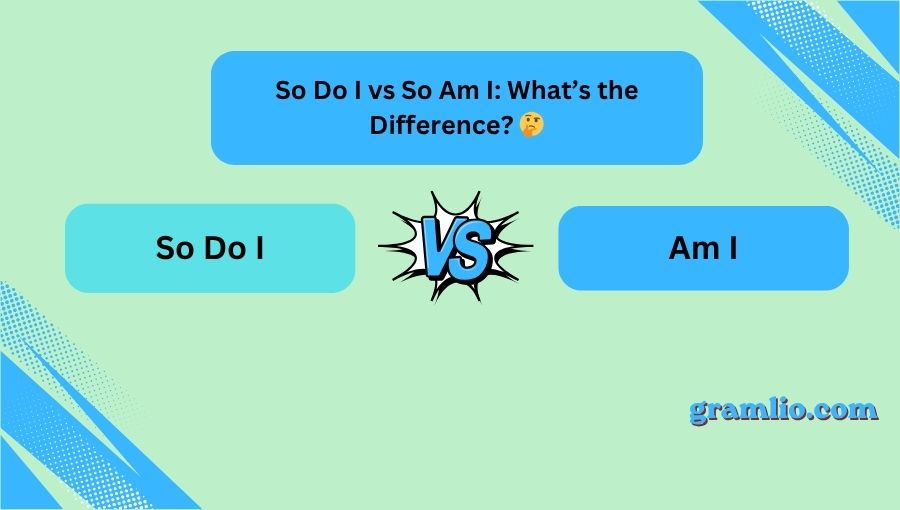
So Do I vs So Am I: What’s the Difference? 🤔
So Do I vs So Am I is one of the most confusing grammar points for English learners, especially when trying to respond naturally in conversations. Have you ever heard someone say, “I like coffee,” and you replied, “So am I,” only to feel unsure if it was correct? Or maybe someone said, “I am tired,” and you hesitated between “So do I” and “So am I.” If yes, you are not alone. 😊
The confusion around So Do I vs So Am I happens because both phrases are used to show agreement, but they follow completely different grammar rules. One depends on action verbs, while the other depends on the verb “to be.” Mixing them can make sentences sound unnatural or grammatically incorrect.
Understanding So Do I vs So Am I is important for speaking fluent, natural English in everyday conversations, exams, and professional communication. The good news is that the rule is simple once you learn how auxiliary verbs work.
In this guide, you’ll clearly understand the difference, see practical examples, avoid common mistakes, and master this grammar point with confidence.
Quick Answer: So Do I vs So Am I ⚡

So Do I and So Am I are both used to agree with another person’s statement.
- Use So do I when agreeing with actions using the verb do or other regular verbs.
- Use So am I when agreeing with statements using the verb to be (am/is/are).
Examples:
- “I like coffee.” → “So do I.” ✅
- “I am tired.” → “So am I.” ✅
The helping verb changes depending on the original sentence.
Understanding the Basics of So Do I vs So Am I
The core difference is simple:
The auxiliary verb in your response must match the original sentence.
If the original sentence uses be verbs, use am/is/are.
If it uses action verbs, use do/does/did.
Comparison Table
| Form | Type | Meaning | Example | Correct/Incorrect |
|---|---|---|---|---|
| So do I | Agreement with action verbs | I feel the same way | “I play tennis.” → “So do I.” | ✅ Correct |
| So am I | Agreement with be verbs | I also have that condition/state | “I am hungry.” → “So am I.” | ✅ Correct |
| So am I | Used after action verbs | Wrong auxiliary | “I like tea.” → “So am I.” | ❌ Incorrect |
| So do I | Used after be verbs | Wrong auxiliary | “I am happy.” → “So do I.” | ❌ Incorrect |
The key is not memorizing phrases. The key is matching the helping verb.
Correct Meanings & Uses
Using “So Do I” Correctly ✅
Use So do I after statements with action verbs.
Examples:
Person A: “I enjoy reading mystery books.”
Person B: “So do I.”
Breakdown:
- Main verb: enjoy
- Type: action verb
- Helper used: do
- Correct response: So do I
More examples:
- “I watch movies every weekend.” → “So do I.”
- “I love ice cream.” → “So do I.”
- “I work from home.” → “So do I.”
Test Tip 🎯
Ask yourself:
Is there an action verb?
If yes, use do/does/did.
Using “So Am I” Correctly ✅
Use So am I when the sentence uses the verb to be.
Examples:
Person A: “I am excited about the trip.”
Person B: “So am I.”
Breakdown:
- Main verb: am
- Type: be verb
- Matching helper: am
- Correct response: So am I
More examples:
- “I am nervous.” → “So am I.”
- “I am ready.” → “So am I.”
- “I am happy today.” → “So am I.”
Test Tip 🎯
Look for:
- am
- is
- are
If one appears, match it.
Other Related Forms
The same rule applies to other helping verbs:
- “I can swim.” → “So can I.”
- “I have finished.” → “So have I.”
- “I will go.” → “So will I.”
English loves matching helper verbs.
Case Study Section 📚
Imagine a workplace meeting.
Manager: “I am excited about the new project.”
Employee 1: “So am I.” ✅
Employee 2: “So do I.” ❌
Why is Employee 2 wrong?
Because the original statement uses am, not an action verb.
Now another example:
Manager: “I enjoy working with this team.”
Employee 1: “So do I.” ✅
Employee 2: “So am I.” ❌
Real conversations depend on matching verbs correctly.
Grammar Rules Explanation
Standard grammar references explain that short agreement responses repeat the auxiliary verb from the original sentence.
The principle is based on subject–auxiliary inversion.
Structure:
So + auxiliary verb + subject
Examples:
- So do I
- So am I
- So can I
- So have I
According to traditional grammar principles recognized by dictionaries and authorities such as Merriam-Webster, auxiliary verbs help support sentence structure and maintain grammatical agreement.
The grammar pattern works because English relies heavily on auxiliary matching.
Formula:
So + helping verb + subject
Examples:
| Original Sentence | Response |
|---|---|
| I am tired | So am I |
| I like coffee | So do I |
| I can drive | So can I |
| I have eaten | So have I |
Common Mistakes ❌
People often mix up So Do I vs So Am I because the phrases sound similar.
Common reasons:
Fast typing ⌨️
People type quickly and choose the first phrase that comes to mind.
Autocorrect 📱
Phones sometimes predict commonly used structures.
Lack of grammar knowledge 📘
Many learners memorize phrases without understanding the rule.
Similar Grammar Confusions
| Confusing Pair | Correct Difference |
|---|---|
| it’s / its | contraction vs possession |
| your / you’re | ownership vs you are |
| affect / effect | verb vs noun |
| then / than | time vs comparison |
| so do I / so am I | action verbs vs be verbs |
Learning patterns prevents repeated mistakes.
Usage in Different Contexts
Everyday Conversation ☕
Friend: “I love burgers.”
You: “So do I.”
Friend: “I am hungry.”
You: “So am I.”
Simple and natural.
Professional Writing 💼
Coworker: “I am interested in the proposal.”
Response:
“So am I.”
Professional communication benefits from accurate grammar.
Creative Writing ✍️
Character A:
“I am afraid.”
Character B:
“So am I.”
Writers use these structures in dialogue all the time.
Social Media and Texting 📱
Post:
“I love staying up late.”
Comment:
“So do I 😂”
Post:
“I’m exhausted after work.”
Comment:
“So am I 😴”
Even online writing follows grammar rules.
Why It Matters ⭐
Correct grammar is more than a school rule.
It affects:
Clarity in communication
People understand you immediately.
Professionalism
Correct English creates a stronger impression.
Accuracy in digital communication
Emails, messages, and presentations become clearer.
As the saying goes:
“Good communication begins with clear language.”
Tiny grammar details can make a big difference.
Special Exception 🔍
There are very few exceptions.
In casual speech, some people accidentally say:
“So am I” after action verbs.
Example:
“I like soccer.”
“So am I.”
Native speakers may understand the intended meaning, but it still sounds grammatically awkward.
Also, songs, brand slogans, or creative writing may intentionally break grammar rules for style.
Outside those cases, follow the standard rule.
Quick Recap Checklist ✅
| Question | If Yes → Use |
|---|---|
| Does the sentence use am/is/are? | So am I |
| Does it use an action verb? | So do I |
| Does it use can? | So can I |
| Does it use have? | So have I |
| Does it use will? | So will I |
Practice:
- “I am sleepy.” → ______
Answer: So am I - “I enjoy swimming.” → ______
Answer: So do I - “I can dance.” → ______
Answer: So can I
Frequently Asked Questions (FAQs)
1. What is the difference between So Do I vs So Am I?
So do I agrees with action verbs, while So am I agrees with be verbs like am, is, and are.
2. Can I use So Am I after “I like pizza”?
No. “Like” is an action verb.
Correct:
“I like pizza.”
“So do I.” ✅
3. Why do English speakers use “so” in these responses?
“So” shows agreement and means “the same is true for me.”
4. Is “So Do I” formal or informal?
It works in both formal and informal English.
5. Can I use “Me too” instead?
Yes. “Me too” often replaces both phrases in casual speech.
Examples:
“I love music.”
“Me too.”
However, So do I is more grammatically structured.
6. What happens with past tense?
Match the helping verb.
Example:
“I liked that movie.”
“So did I.”
Conclusion
Understanding So Do I vs So Am I becomes easy once you remember one important rule: match the helping verb from the original sentence. If someone uses an action verb, use So do I. If someone uses a form of the verb to be, use So am I.
The mistake happens because both phrases express agreement, but English grammar requires the structure to stay consistent. Small differences create big improvements in communication. 😊
The next time someone says, “I am excited,” you will know exactly how to respond. And if they say, “I enjoy learning English,” you will confidently answer, “So do I.”
Master the pattern, trust the rule, and your English will sound smoother every day. 🚀
Also Read This: Backyard or Back Yard

I’m Adrian Bellmont, and I work at Gramlio. I’m an expert in grammar and enjoy breaking down complex language rules into simple ideas.