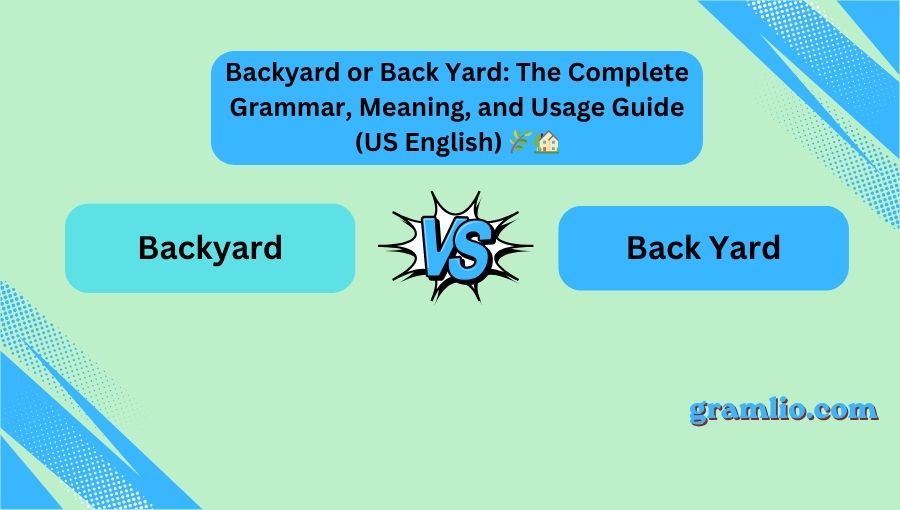
Backyard or Back Yard: The Complete Grammar, Meaning, and Usage Guide (US English) 🌿🏡
Have you ever stopped while writing and wondered whether it should be “Backyard or Back Yard”? 🤔 This small grammar confusion is more common than you think, especially for students, bloggers, and professional writers. At first glance, both forms look correct, but English usage rules clearly favor one over the other in modern writing.
The keyword Backyard or Back Yard creates confusion because both versions have appeared in English over time. While “backyard” is now widely accepted as a single-word compound noun in American English, “back yard” is still occasionally seen in older texts or more descriptive writing. This difference often leads to mistakes in academic writing, digital content creation, and everyday communication.
In this article, we will clearly break down Backyard or Back Yard, explain which form is correct today, and show you when each version should be used. You’ll also learn grammar rules, real-life examples, common mistakes, and professional writing tips so you never get confused again. 🌿
Quick Answer: Backyard or Back Yard

The correct and most commonly used modern form is “backyard” (one word), especially in American English. It refers to the outdoor area behind a house.
The form “back yard” (two words) is older and sometimes used when “back” is treated as a descriptive adjective meaning the yard located at the rear of a property. However, in today’s writing, “backyard” is the standard spelling in dictionaries, newspapers, and digital content.
👉 In short:
- Backyard = Correct (modern usage, noun)
- Back yard = Less common (older or descriptive form)
Understanding the Basics: Backyard or Back Yard
To fully understand Backyard or Back Yard, we need to break it down into grammar structure, meaning, and usage evolution.
What Does “Backyard” Mean?
A backyard is:
- The outdoor space behind a house
- A private or semi-private residential area
- Often used for gardening, relaxing, or outdoor activities 🌳
What Does “Back Yard” Mean?
A back yard literally means:
- “Back” (directional adjective) + “yard” (noun)
- The yard located at the back of a property
Key Grammar Insight
Over time, English tends to combine frequently used compound nouns into a single word. That’s why:
- “back + yard” → backyard
Comparison Table: Backyard vs Back Yard
| Feature | Backyard | Back Yard |
|---|---|---|
| Form | One word | Two words |
| Type | Compound noun | Phrase (adj + noun) |
| Meaning | Outdoor area behind house | Yard at back of house |
| Usage | Modern English (US/UK) | Older / descriptive use |
| Correct today? | ✅ Yes | ⚠️ Rare |
Correct Meanings & Uses
1. Backyard as a Noun (Most Common Usage)
In modern English, backyard functions as a noun.
Examples:
- We had a barbecue in the backyard last weekend. 🍔
- The children are playing in the backyard.
- She planted flowers in her backyard garden.
Sentence Breakdown:
- Subject: She
- Verb: planted
- Object: flowers
- Location: backyard garden
👉 This shows how naturally “backyard” functions as a single unit.
2. Back Yard as a Descriptive Phrase (Less Common)
Sometimes, writers use back yard when they want to emphasize “back” as a descriptive adjective.
Examples:
- The house has a large back yard space.
- He repaired the fence in the back yard area.
👉 This usage is more formal, technical, or older in style.
Test Tip 🧠
If you can replace it with a single noun like “garden” or “park space,” then use “backyard”.
Example:
- ✔ We cleaned the backyard → correct
- ❌ We cleaned the back yard → outdated in modern writing
Case Study Section: Real-Life Usage Example
Scenario: Email to a Property Manager
Incorrect Version:
The tenants damaged the back yard and left trash everywhere.
Correct Modern Version:
The tenants damaged the backyard and left trash everywhere. 🌿
Why It Matters:
- “Backyard” sounds more natural and professional.
- It aligns with modern US English usage.
- It improves readability in formal communication.
Grammar Rules Explanation
So, why is “backyard” correct and preferred?
1. Compound Word Formation
English often merges common phrases into single words:
- notebook (note + book)
- toothpaste (tooth + paste)
- backyard (back + yard)
2. Dictionary Standardization
Leading dictionaries like:
- Merriam-Webster
- Oxford English Dictionary
list “backyard” as the primary form.
3. Usage Frequency
Modern usage strongly favors:
- backyard (dominant in media, books, SEO content)
Conclusion of Rule:
✔ “Backyard” is the standardized compound noun
⚠️ “Back yard” is grammatically possible but outdated
Common Mistakes
Why People Get Confused
People often mix Backyard or Back Yard due to:
- Fast typing ⌨️
- Auto-correct errors
- Learning from outdated texts
- Influence of British vs American spelling differences
Common Grammar Confusion Table
| Incorrect Form | Correct Form | Reason |
|---|---|---|
| your house back yard | backyard | modern compound noun |
| it’s garden | its garden | contraction error |
| there backyard | their backyard | homophone confusion |
| back yard cleaning | backyard cleaning | compound noun usage |
Usage in Different Contexts
1. Everyday Conversation 🗣️
- “Let’s meet in the backyard.”
2. Professional Writing 💼
- “The property includes a landscaped backyard.”
3. Creative Writing ✍️
- “The mysterious sound came from the backyard at midnight.”
4. Social Media 📱
- “Weekend vibes in my backyard 🌿☀️”
Why It Matters (Important)
Using the correct form of Backyard or Back Yard is important because:
- It improves clarity in communication
- It enhances professional writing quality
- It boosts SEO performance in digital content
- It reflects language accuracy and credibility
📢 As linguists often emphasize:
“Standardized spelling improves readability and trust in written communication.”
Special Exception
In some cases, “back yard” may still appear:
- Legal documents (property descriptions)
- Architectural plans
- Older literature
However, these are exceptions, not the rule.
Quick Recap Checklist
| Question | If Yes → Use |
|---|---|
| Is it modern writing? | backyard |
| Is it casual conversation? | backyard |
| Is it technical/legal description? | back yard (rare) |
Practice Examples
- We painted the backyard fence.
- The backyard is full of flowers.
- Children are playing in the backyard.
FAQs: Backyard or Back Yard
1. Is “backyard” one word or two words?
“Backyard” is one word in modern English and is the correct standard form.
2. Is “back yard” ever correct?
Yes, but it is rare and usually used in older or technical writing.
3. Which spelling is better for SEO?
“Backyard” is better because it is the widely accepted modern keyword.
4. Do British and American English differ here?
Both prefer “backyard,” though British English may occasionally show “back yard” in older texts.
5. Can I use both forms interchangeably?
No. In modern writing, always prefer “backyard” unless context specifically requires separation.
6. What does “backyard” symbolize?
It symbolizes home space, relaxation, nature, and personal outdoor living. 🌿
Conclusion
Understanding the difference between Backyard or Back Yard is simple once you know the rule: modern English strongly prefers “backyard” as one word. It is the standard form used in dictionaries, professional writing, digital content, and everyday communication.
While “back yard” is not grammatically wrong, it is considered outdated and is rarely used in modern contexts unless for specific descriptive or technical reasons. Over time, English naturally combines frequently used phrases into single words, and “backyard” is a perfect example of this evolution.
For clear, professional, and SEO-friendly writing, always choose “backyard.” It improves readability, aligns with modern standards, and avoids confusion.
So the next time you write about that cozy outdoor space behind a house 🌿—you’ll know exactly what to use. One word, one meaning, zero confusion: backyard is the way to go.
Also Read This: Analog vs Analogue

I’m Caleb Whitmore, and I work at Gramlio. I’m an expert in grammar and help readers understand English with simple explanations and real-life examples.