Concurrent vs Simultaneous: What’s the Difference and When Should You Use Each? 🤔
Have you ever wondered about the difference between Concurrent vs Simultaneous when describing events that happen at the same time? You are not alone. Many English learners, students, writers, and professionals confuse these two words because they both relate to timing and overlapping actions.
The terms concurrent vs simultaneous may seem identical, but they have important differences in meaning and usage. Concurrent usually describes events that happen during the same period, while simultaneous refers to events that occur at the exact same moment.
Imagine two meetings taking place during the same hour in different rooms. They are concurrent because their time periods overlap. But if two people start speaking at precisely the same second, their actions are simultaneous.
Understanding this difference helps improve accuracy in everyday conversations, workplace communication, academic writing, technology, and professional documents. In this guide, you will learn how to use concurrent vs simultaneous correctly, discover common mistakes, and understand simple rules that make choosing the right word easier. ✅
Quick Answer: Concurrent vs Simultaneous
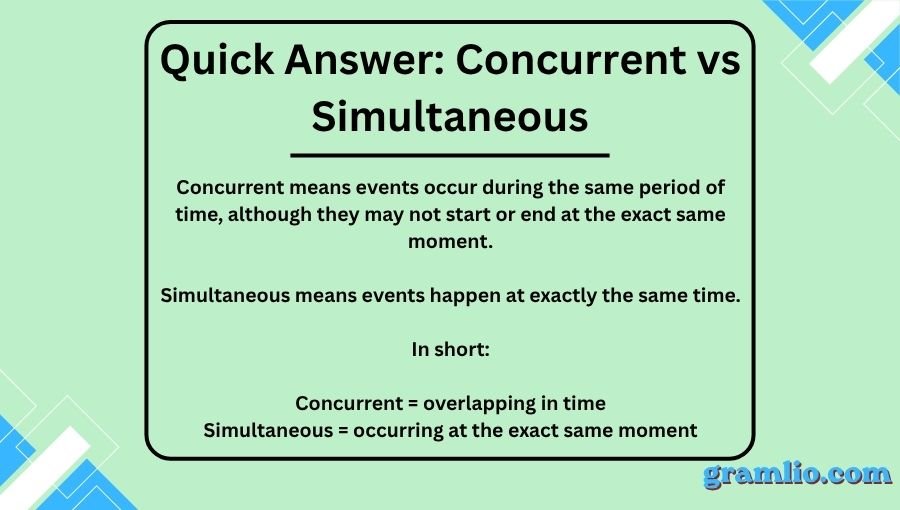
Concurrent means events occur during the same period of time, although they may not start or end at the exact same moment.
Simultaneous means events happen at exactly the same time.
In short:
- Concurrent = overlapping in time
- Simultaneous = occurring at the exact same moment
Understanding the Basics of Concurrent vs Simultaneous
The confusion between concurrent vs simultaneous arises because both words describe multiple events happening within the same timeframe.
The key difference is precision.
| Feature | Concurrent | Simultaneous |
|---|---|---|
| Form | Adjective | Adjective |
| Type | Time-related term | Time-related term |
| Meaning | Happening during the same period | Happening at exactly the same time |
| Example | Two courses running during one semester | Two bells ringing at the exact same second |
| Correct/Incorrect | Correct when time periods overlap | Correct when timing is identical |
Simple Comparison
✅ Two construction projects running throughout the year are concurrent.
✅ Two fireworks exploding at the exact same second are simultaneous.
Although simultaneous events are technically concurrent, not all concurrent events are simultaneous.
Think of it like this:
📅 Concurrent = Same timeframe
⏰ Simultaneous = Same exact moment
Correct Meanings and Uses
What Does Concurrent Mean?
The word concurrent comes from Latin roots meaning “running together.”
It refers to events, activities, or processes that occur during the same period but not necessarily at the exact same instant.
Examples
- The company managed three concurrent projects.
- The university offers concurrent degree programs.
- Several concurrent investigations are underway.
Sentence Breakdown
The company managed three concurrent projects.
- Three projects existed during the same period.
- They may have started and ended on different dates.
- The projects overlap in time.
Test Tip 💡
Ask yourself:
Do the activities overlap in time without needing perfect synchronization?
If yes, use concurrent.
What Does Simultaneous Mean?
The word simultaneous means occurring at precisely the same moment.
This word emphasizes exact timing.
Examples
- The two runners crossed the finish line simultaneously.
- Simultaneous explosions were heard across the city.
- The dancers moved simultaneously.
Sentence Breakdown
The dancers moved simultaneously.
- Their movements occurred at the same moment.
- The timing was synchronized.
- Exact coordination is emphasized.
Test Tip 💡
Ask yourself:
Did the events happen at the exact same moment?
If yes, use simultaneous.
Concurrent in Business Settings
Business professionals frequently use concurrent.
Examples
- The manager supervised concurrent teams.
- Multiple concurrent contracts were active.
- The software supports concurrent users.
In these cases, activities overlap but may not occur at precisely the same second.
Simultaneous in Scientific and Technical Contexts
Scientists and engineers often use simultaneous when exact timing matters.
Examples
- Simultaneous measurements were recorded.
- Researchers observed simultaneous reactions.
- The system triggers simultaneous alerts.
Precision is the primary focus.
Case Study Section
Workplace Example
Imagine a marketing company launching multiple campaigns.
Scenario 1: Concurrent Campaigns
Campaign A runs from January to March.
Campaign B runs from February to April.
These campaigns overlap.
✅ Correct term: Concurrent
Scenario 2: Simultaneous Launch
Campaign A and Campaign B both begin at exactly 9:00 AM on February 1.
✅ Correct term: Simultaneous
Email Example
Incorrect:
“We are conducting three simultaneous projects this quarter.”
This suggests all project activities occur at exactly the same moments.
Better:
“We are conducting three concurrent projects this quarter.”
This correctly indicates overlapping projects.
Conversation Example
Person A: “Were the concerts simultaneous?”
Person B: “No, they were concurrent. One started thirty minutes after the other.”
This example clearly shows the distinction.
Grammar Rules Explanation
Understanding the grammar behind concurrent vs simultaneous helps ensure proper usage.
According to standard dictionary authorities such as Merriam-Webster, both words are adjectives describing time-related relationships between events.
Rule 1: Use Concurrent for Overlapping Time Periods
Correct:
- Concurrent programs
- Concurrent responsibilities
- Concurrent projects
Why?
The activities share a timeframe but not necessarily exact timing.
Rule 2: Use Simultaneous for Exact Timing
Correct:
- Simultaneous applause
- Simultaneous arrivals
- Simultaneous reactions
Why?
The emphasis is on occurring at the exact same moment.
Rule 3: Avoid Unnecessary Substitution
Sometimes replacing one word with the other changes meaning.
Example
“The software supports concurrent users.”
Correct because users access the system during the same period.
“The software supports simultaneous users.”
Possible, but it specifically emphasizes exact same-time access.
The nuance changes.
Common Mistakes
Many writers confuse these words because both relate to time.
Why Mistakes Happen
Fast Typing ⌨️
Writers often choose whichever word comes to mind first.
Autocorrect
Some software tools may not flag the misuse.
Lack of Knowledge
Many people learn the words as synonyms without understanding the distinction.
Common Incorrect Usage
Incorrect
“The company has five simultaneous projects this year.”
Better
“The company has five concurrent projects this year.”
Projects overlap but do not occur every second together.
Similar Grammar Confusions
| Confusing Pair | Difference |
|---|---|
| It’s vs Its | Contraction vs possession |
| Your vs You’re | Possessive vs contraction |
| Affect vs Effect | Verb vs noun |
| Then vs Than | Time vs comparison |
| Concurrent vs Simultaneous | Overlapping vs exact timing |
| Further vs Farther | Figurative vs physical distance |
Usage in Different Contexts
Everyday Conversation
People often use both words casually.
Examples
- We had concurrent appointments.
- We spoke simultaneously.
The second sentence emphasizes exact timing.
Professional Writing
Professional communication benefits from precision.
Examples
- The organization manages concurrent initiatives.
- Simultaneous approval is required from all departments.
Correct word choice improves clarity.
Creative Writing
Authors use both words to create vivid descriptions.
Example
“The bells rang simultaneously as the crowd cheered.”
Example
“Several concurrent storylines unfolded throughout the novel.”
Social Media and Texting
Social media users frequently overlook the distinction.
Example
“I was on two concurrent video calls.”
Example
“We both posted simultaneously! 😂”
These examples sound natural and accurate.
Why It Matters
Choosing between concurrent vs simultaneous may seem minor, but it affects communication quality.
Clarity in Communication
Accurate word choice prevents misunderstanding.
Example
A project manager discussing concurrent tasks communicates more precisely than one using simultaneous incorrectly.
Professionalism
Employers, educators, and clients notice careful language use.
Correct terminology demonstrates expertise and attention to detail.
Writing Accuracy in Digital Communication
Emails, reports, presentations, and documentation rely on precise wording.
Using the correct term helps readers understand timing relationships immediately.
Quote
“Precision in language leads to precision in thought.”
This principle applies perfectly to concurrent and simultaneous usage.
Special Exception
In most situations, the distinction remains clear.
However, some fields use the words differently.
Computing and Technology
In computer science, concurrent and simultaneous have specialized meanings.
Concurrent Processing
Tasks progress during overlapping periods.
Simultaneous Processing
Tasks literally execute at the same moment on separate processors.
Therefore, technical discussions may require greater precision than everyday language.
Legal Terminology
Courts sometimes use concurrent sentences.
This means multiple prison sentences are served at the same time rather than one after another.
In this context, concurrent is the standard legal term.
Quick Recap Checklist
Use this table whenever you’re unsure.
| Question | If Yes → Use |
|---|---|
| Do the events overlap in time? | Concurrent |
| Do they occur during the same period? | Concurrent |
| Do they happen at exactly the same moment? | Simultaneous |
| Is exact synchronization important? | Simultaneous |
| Are multiple projects running together? | Concurrent |
| Are actions occurring at the exact same second? | Simultaneous |
Practice Examples
Example 1
The company managed four _____ projects.
✅ Concurrent
Example 2
The twins answered the question _____.
✅ Simultaneously
Example 3
Several investigations were _____ throughout the year.
✅ Concurrent
FAQs About Concurrent vs Simultaneous
Is concurrent the same as simultaneous?
No. Concurrent means events occur during the same timeframe, while simultaneous means they occur at exactly the same moment.
Which word is more precise?
Simultaneous is generally more precise because it refers to identical timing. Concurrent refers to overlapping periods.
Can concurrent events be simultaneous?
Yes. Simultaneous events are also concurrent because they occur during the same timeframe. However, many concurrent events are not simultaneous.
Is it correct to say concurrent projects?
Yes. This is one of the most common uses of concurrent. It means multiple projects are active during the same period.
What is a simple way to remember the difference?
Remember:
📅 Concurrent = same timeframe
⏰ Simultaneous = same exact moment
Which term is used more in business?
Concurrent is more common in business because projects, responsibilities, and operations often overlap rather than occur at identical moments.
Conclusion
Understanding concurrent vs simultaneous is easier once you focus on timing precision. Both words involve events happening within the same general timeframe, but they are not identical. Concurrent describes activities that overlap during a period of time, while simultaneous describes activities occurring at the exact same moment.
This distinction is important in business, education, technology, professional writing, and everyday communication. Using the correct term improves clarity, prevents misunderstandings, and makes your writing appear more polished and professional.
Whenever you are unsure, remember this simple rule:
📅 Concurrent = overlapping time periods
⏰ Simultaneous = exact same moment
Mastering this small difference can make a big impact on the accuracy and effectiveness of your communication. Choose your words carefully, and your message will always be clearer. ✨
Also Read This: Anyplace vs Any Place

I’m Ethan Holloway, and I work at Gramlio. I’m an expert in grammar and focus on making confusing English rules easy to understand.