Affect vs Effect: The Complete Guide to Using These Commonly Confused Words Correctly ✍️📚
Have you ever paused while writing an email, school assignment, or social media post because you couldn’t decide whether to use affect vs effect? 🤔 You’re not alone. Even native English speakers mix up these two words because they look and sound similar, yet they serve different grammatical purposes.
Understanding affect vs effect is one of the most valuable grammar skills you can learn. Using the correct word makes your writing clearer, more professional, and easier to understand. Whether you’re writing a business report, sending an important email, creating website content, or simply chatting with friends, knowing the difference helps you communicate with confidence.
The good news is that the distinction isn’t as difficult as it seems. Once you understand the basic rule, recognize a few exceptions, and practice with real-life examples, you’ll be able to choose the correct word naturally.
This comprehensive guide to affect vs effect explains everything in simple US English, includes practical examples, grammar tips, comparison tables, common mistakes, FAQs, and expert advice to help you master these commonly confused words.
Quick Answer: Affect vs Effect ⚡
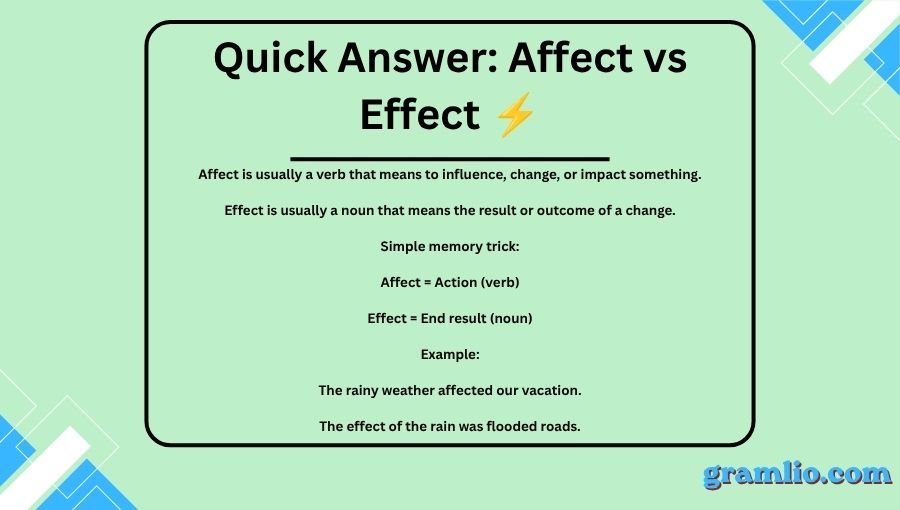
Affect is usually a verb that means to influence, change, or impact something.
Effect is usually a noun that means the result or outcome of a change.
Simple memory trick:
- Affect = Action (verb)
- Effect = End result (noun)
Example:
- The rainy weather affected our vacation.
- The effect of the rain was flooded roads.
Understanding the Basics of Affect vs Effect
Although these words sound similar, they perform different jobs in a sentence.
| Form | Affect | Effect |
|---|---|---|
| Type | Usually a Verb | Usually a Noun |
| Meaning | To influence or change | The result or outcome |
| Example | The news affected everyone. | The effect was immediate. |
| Correct/Incorrect | ✅ Affect the results | ❌ Effect the results (usually incorrect) |
The Core Difference
Think of the process like this:
Cause ➜ Affect ➜ Effect
Something happens.
⬇️
It affects something.
⬇️
The final effect becomes visible.
Example:
- Lack of sleep affects concentration.
- Poor concentration is the effect of lack of sleep.
Correct Meanings and Uses
Using “Affect” Correctly
The word affect usually acts as a verb.
It means:
- To influence
- To change
- To impact
- To alter
Examples
✅ The new law affects small businesses.
Sentence breakdown:
- Subject: The new law
- Verb: affects
- Object: small businesses
Meaning:
The law influences businesses.
✅ Stress can affect your health.
Meaning:
Stress changes your physical or mental health.
✅ Heavy traffic affected our arrival time.
Meaning:
Traffic influenced when we arrived.
Test Tip 💡
Ask yourself:
Can I replace the word with “influence” or “impact”?
If yes, affect is probably correct.
Example:
The weather affected our plans.
↓
The weather influenced our plans.
It works.
Using “Effect” Correctly
Effect is generally a noun.
It refers to:
- A result
- A consequence
- An outcome
Examples
✅ The medicine had a positive effect.
Meaning:
The medicine produced a positive result.
✅ One effect of exercise is better sleep.
Meaning:
Better sleep is the outcome.
✅ The policy had little effect on sales.
Meaning:
The policy produced little result.
Test Tip 💡
Ask yourself:
Can I replace it with “result” or “outcome”?
If yes, effect is correct.
Example:
The effect was immediate.
↓
The result was immediate.
Perfect!
Side-by-Side Comparison
| Sentence | Correct Word | Why? |
|---|---|---|
| The storm ____ travel. | affected | It’s an action. |
| The ____ of the storm was flooding. | effect | It’s the result. |
| Poor nutrition can ____ growth. | affect | Influence |
| The side ____ included headaches. | effect | Result |
Case Study: Workplace Email Example 📧
Imagine Sarah sends this email:
The new scheduling software has affected our workflow. One positive effect is that projects are now completed two days earlier.
Let’s analyze it.
Affected
The software changed the workflow.
It performed an action.
Correct word:
✅ affected
Effect
Projects finish sooner.
That’s the result.
Correct word:
✅ effect
This is exactly how these words appear in professional writing every day.
Grammar Rules Explained
According to Merriam-Webster, affect is primarily a verb meaning “to produce an effect upon.”
Likewise, effect is primarily a noun meaning “something produced by a cause.”
Grammar experts consistently recommend remembering their usual grammatical roles:
- Affect → Verb
- Effect → Noun
Examples:
Correct:
- Exercise affects mood.
Incorrect:
- Exercise effects mood.
Correct:
- The effect was noticeable.
Incorrect:
- The affect was noticeable.
The Rare Exceptions
English always has exceptions!
Effect as a Verb
Sometimes effect is a verb.
Meaning:
To bring about or accomplish.
Example:
The CEO hopes to effect major organizational changes.
Meaning:
The CEO wants to make those changes happen.
This use appears mainly in:
- Business writing
- Legal writing
- Government documents
It is uncommon in everyday English.
Affect as a Noun
In psychology, affect can be a noun.
Meaning:
A person’s observable emotional expression.
Example:
The patient displayed a flat affect.
Unless you’re studying psychology or medicine, you rarely need this usage.
Common Mistakes
Why do people confuse affect and effect?
Several reasons contribute to this mistake.
1. Similar pronunciation 🔊
They sound almost identical.
2. Fast typing ⌨️
People often type quickly without proofreading.
3. Autocorrect 📱
Autocorrect may replace one word with the other.
4. Lack of grammar knowledge 📖
Many people were never taught the simple difference.
Similar Grammar Confusions
| Confusing Pair | Difference |
|---|---|
| It’s / Its | Contraction vs possession |
| Your / You’re | Possession vs “you are” |
| Then / Than | Time vs comparison |
| To / Too | Direction vs “also” |
| Lose / Loose | Misplace vs not tight |
| Affect / Effect | Influence vs result |
Memory Tricks That Actually Work 🧠
Trick 1
Affect = Action
Both begin with A.
Action = Verb
Trick 2
Effect = End Result
Both begin with E.
End Result = Noun
Trick 3
AIR Formula
A = Affect = Influence
E = Effect = End Result
Simple.
Easy.
Memorable.
Usage in Different Contexts
Everyday Conversation 🗣️
Correct:
The weather affected my mood.
The effect lasted all day.
Professional Writing 💼
Managers often write:
The budget cuts affected production.
The effect was a 10% reduction in expenses.
Academic Writing 🎓
Researchers write:
Climate change affects ecosystems.
One effect is habitat loss.
Creative Writing ✍️
The mysterious letter affected her deeply.
Its effect stayed with her for years.
Social Media and Texting 📱
Even casual writing benefits from proper grammar.
Correct:
Coffee affects my sleep.
The effect is obvious.
Using the right word builds credibility, even in short posts.
Why It Matters 🌟
Choosing between affect and effect is more than a grammar exercise.
It improves every aspect of communication.
1. Clarity
Readers instantly understand your meaning.
2. Professionalism
Correct grammar creates a positive impression.
Employers, clients, and teachers notice accurate writing.
3. Writing Accuracy
Precise language reduces misunderstandings.
This is especially important in:
- Business
- Education
- Marketing
- Healthcare
- Law
4. Better Digital Communication
Search engines, AI tools, and readers all prefer well-written content.
Clear grammar improves readability and trust.
“Clear writing reflects clear thinking.”
Practice Examples
Choose the correct word.
Example 1
The loud music _____ my concentration.
✅ affected
Example 2
The medicine had an immediate _____.
✅ effect
Example 3
Climate change continues to _____ coastal communities.
✅ affect
Example 4
One positive _____ of regular exercise is increased energy.
✅ effect
Example 5
The decision affected every employee.
Correct because it describes an action.
Special Exceptions
Although the standard rule works in almost every situation, keep these exceptions in mind.
Business and Legal English
“Effect” may mean:
To make happen.
Example:
The committee effected several policy changes.
Psychology
“Affect” refers to emotional expression.
Example:
The patient’s affect remained calm.
Outside these specialized fields, follow the basic rule:
Affect = Verb
Effect = Noun
Quick Recap Checklist ✅
| Question | If Yes → Use |
|---|---|
| Is it an action? | Affect |
| Does it mean influence? | Affect |
| Is it a result? | Effect |
| Does it mean outcome? | Effect |
| Can you replace it with “impact”? | Affect |
| Can you replace it with “result”? | Effect |
Practice Yourself
1.
The storm _____ thousands of flights.
Answer:
✅ affected
2.
The long-term _____ remains unknown.
Answer:
✅ effect
3.
Poor communication can _____ teamwork.
Answer:
✅ affect
FAQs
1. What is the difference between affect and effect?
Affect usually means to influence and is generally used as a verb. Effect usually means the result or outcome and is generally used as a noun.
2. Is “affect” always a verb?
No. While affect is usually a verb, it can be a noun in psychology, where it refers to a person’s observable emotional expression.
3. Can “effect” be used as a verb?
Yes. In formal contexts, effect can be a verb meaning to bring about, to accomplish, or to make happen. This usage is uncommon in everyday conversation.
4. How can I remember affect vs effect?
A simple trick is:
- Affect = Action = Verb
- Effect = End Result = Noun
This memory aid works for most everyday writing.
5. Which word appears more often in business writing?
Both appear frequently. Affect is used when describing influence or impact, while effect is used when discussing results or outcomes.
6. Why do spell checkers sometimes miss this mistake?
Because both affect and effect are correctly spelled English words. Spell check verifies spelling, not context, so it may not detect the wrong choice.
Final Examples
Correct:
- The announcement affected investor confidence.
- The effect was a sharp increase in stock prices.
Correct:
- Lack of practice affects performance.
- The effect becomes obvious over time.
Incorrect:
- The weather effected my plans.
Correct:
- The weather affected my plans.
Conclusion
The distinction between affect vs effect becomes much easier once you remember their primary roles. In most situations, affect is a verb that means to influence or change, while effect is a noun that refers to the result or outcome of that influence. Although English includes a few specialized exceptions—such as effect meaning “to bring about” in formal writing and affect referring to emotional expression in psychology—these cases are relatively rare.
Whenever you’re unsure, ask yourself a simple question: Am I describing an action or a result? If it’s an action that influences something, choose affect. If it’s the outcome or consequence, choose effect. This quick check will help you make the correct choice in nearly every situation.
Mastering affect vs effect strengthens your grammar, improves your writing, and enhances your credibility in academic, professional, and everyday communication. Small grammar choices can make a big difference—write with confidence, and let every word have the right effect. 🚀
Also Read This: Moat vs Mote

I’m Ethan Holloway, and I work at Gramlio. I’m an expert in grammar and focus on making confusing English rules easy to understand.