Then vs Than: The Complete Guide to Using Them Correctly ✍️
Have you ever paused while typing a sentence and wondered whether you should write then or than? 🤔 If so, you’re already thinking about one of the most common grammar challenges in English: then vs than. You are not alone. This is one of the most frequent grammar mistakes in English, even among native speakers. Because these two words look and sound similar, many people accidentally use one when they actually mean the other.
Understanding then vs than is important because using the wrong word can completely change the meaning of your sentence. Whether you’re writing an email, posting on social media, completing a school assignment, or preparing a business report, choosing the correct word helps you communicate clearly and professionally.
The good news is that the difference is surprisingly simple once you understand each word’s purpose. In this complete guide, you’ll learn exactly when to use then and than, why people confuse them, practical grammar rules, easy memory tricks, real-life examples, and common mistakes to avoid. By the end, you’ll never second-guess yourself again.
Quick Answer: Then vs Than⚡
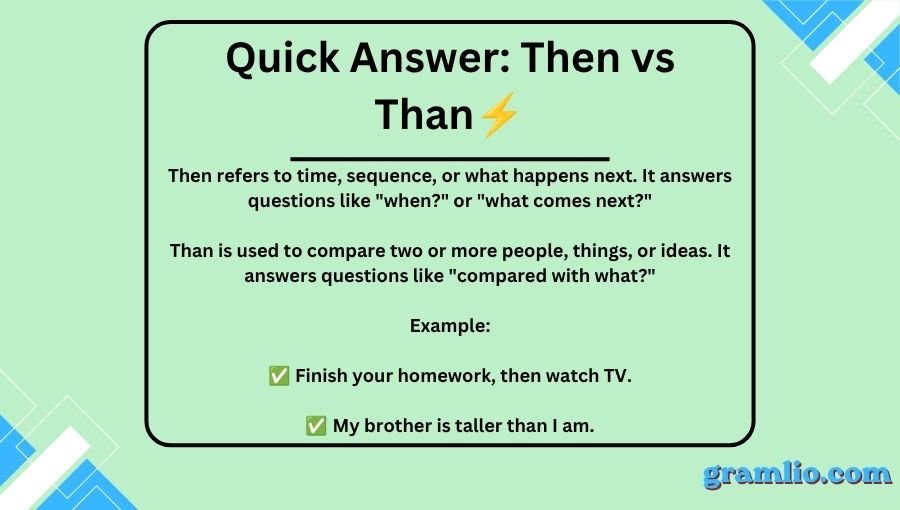
Then refers to time, sequence, or what happens next. It answers questions like “when?” or “what comes next?”
Than is used to compare two or more people, things, or ideas. It answers questions like “compared with what?”
Example:
- ✅ Finish your homework, then watch TV.
- ✅ My brother is taller than I am.
Understanding the Basics of Then vs Than
Although these words differ by only one letter, they serve completely different grammatical purposes.
| Form | Type | Meaning | Example | Correct/Incorrect |
|---|---|---|---|---|
| Then | Adverb, adjective, noun | Refers to time or sequence | We ate dinner, then went home. | ✅ Correct |
| Than | Conjunction, preposition | Used for comparison | She is faster than her friend. | ✅ Correct |
| Then used for comparison | Incorrect | Time word used as comparison | She is taller then me. | ❌ Incorrect |
| Than used for sequence | Incorrect | Comparison word used as time | Finish your work than leave. | ❌ Incorrect |
The Simple Rule 📌
- Think Time = Then
- Think Comparison = Than
That’s the easiest way to remember it.
Correct Meanings and Uses
Using “Then” Correctly ⏰
Then mainly refers to time, order, or sequence.
Meaning 1: Something Happening Next
Examples:
- Wash your hands, then eat.
- Complete Step 1, then continue.
Sentence Breakdown:
- First action: Wash your hands
- Next action: Eat
The word then connects events in chronological order.
Meaning 2: At That Time
Examples:
- Back then, life was simpler.
- She was living in Texas then.
Here, then refers to a specific time in the past.
Meaning 3: As a Result
Examples:
- If that’s true, then we should leave.
- If it rains, then we’ll stay home.
Here, then introduces the result of a condition.
✅ Test Tip
Ask yourself:
Can I replace this word with “next” or “afterward”?
If yes, then is the correct choice.
Using “Than” Correctly 📊
Than is used only when making comparisons.
Meaning 1: Comparing Two Things
Examples:
- Coffee is stronger than tea.
- My laptop is newer than yours.
Sentence Breakdown:
Object 1 → Coffee
Object 2 → Tea
The word than introduces the second item in the comparison.
Meaning 2: Comparing Quantities
Examples:
- More than 100 people attended.
- Less than five minutes remained.
Meaning 3: Comparing Preferences
Examples:
- I’d rather read than watch TV.
- She prefers walking than driving.
(Note: In formal English, “prefer walking to driving” is generally preferred.)
✅ Test Tip
Ask yourself:
Am I comparing two things?
If yes, use than.
Case Study: Real-Life Workplace Example 💼
Imagine you’re sending an email to your manager.
Incorrect Email
I finished the report then Sarah.
This sentence sounds confusing.
It appears to mean:
“I finished the report, and afterward Sarah.”
But the intended meaning is probably:
“I finished the report before Sarah.”
Correct Version
I finished the report earlier than Sarah.
Another example:
Finish the report, then send it to the client.
Here, then correctly shows the order of actions.
This small difference greatly improves clarity and professionalism.
Grammar Rules Explained
According to Merriam-Webster and other standard grammar references:
Rule for Then
Then functions mainly as an adverb indicating:
- Time
- Sequence
- Result
Examples:
- We left, then returned.
- If you agree, then let’s begin.
Rule for Than
Than functions primarily as:
- A conjunction
- A preposition
It introduces the second part of a comparison.
Examples:
- She sings better than I do.
- He earns more than his brother.
Grammar authorities consistently define than as the comparison word and then as the time-related word.
Common Mistakes
People confuse then vs than for several reasons.
Why It Happens
- ⚡ Fast typing
- 📱 Autocorrect
- 📚 Lack of grammar knowledge
- 👂 Similar pronunciation
- 😅 Careless proofreading
Similar Grammar Confusions
| Confusing Pair | Difference |
|---|---|
| It’s / Its | Contraction vs possession |
| Your / You’re | Possessive vs “you are” |
| Their / There / They’re | Possession, location, contraction |
| Affect / Effect | Verb vs noun |
| Accept / Except | Receive vs exclude |
| Then / Than | Time vs comparison |
Incorrect vs Correct Examples
❌ She is smarter then me.
✅ She is smarter than me.
❌ We ate dinner than watched a movie.
✅ We ate dinner then watched a movie.
❌ Better late then never.
✅ Better late than never.
Usage in Different Contexts
Everyday Conversation 🗣️
Examples:
- I’ll call you then.
- You’re taller than your brother.
Professional Writing 💼
Examples:
- Review the proposal, then submit it.
- Sales were higher than expected.
Using the correct word demonstrates attention to detail.
Creative Writing 📖
Examples:
- The sun disappeared, then darkness filled the valley.
- Nothing frightened him more than silence.
Correct usage improves storytelling.
Social Media and Texting 📱
Even informal writing benefits from correct grammar.
Examples:
✅ See you then!
✅ This movie is better than the first one.
Small grammar choices make posts easier to understand.
Why It Matters 🌟
Many people underestimate the importance of choosing between then and than, but this tiny difference has a big impact.
Clarity in Communication
Readers instantly understand your intended meaning.
Professionalism
Correct grammar improves:
- Emails
- Job applications
- Business reports
- Academic writing
Writing Accuracy in Digital Communication
Whether you’re texting, blogging, or posting on LinkedIn, using the correct word makes your writing more polished.
“Clear writing reflects clear thinking.”
Using then and than correctly is one small habit that strengthens every piece of writing.
Special Exceptions
Fortunately, then vs than has very few exceptions.
However, note these situations:
Idioms
Correct:
- Better late than never.
- More often than not.
These expressions always use than because they involve comparison.
Historical Usage
Older English literature may occasionally contain structures that feel unusual today, but modern standard English follows the rules explained in this guide.
Easy Memory Tricks 🧠
Remember these simple tips.
Then = Time
Both then and time relate to when something happens.
Examples:
- First this…
- Then that.
Than = Comparison
Than appears in comparison phrases:
- Bigger than
- Faster than
- Better than
Whenever you’re comparing, think than.
Quick Recap Checklist ✅
| Question | If Yes → Use |
|---|---|
| Are you talking about time? | Then |
| Is something happening next? | Then |
| Are you comparing two things? | Than |
| Does the sentence include “more,” “less,” “better,” or “worse”? | Than |
| Could you replace the word with “next”? | Then |
Practice Examples
Example 1
She is older ____ her sister.
✅ Than
Example 2
Finish your lunch, ____ we’ll leave.
✅ Then
Example 3
This book is more interesting ____ that one.
✅ Than
FAQs
1. What is the main difference between then and than?
Then refers to time or sequence, while than is used to compare two or more things.
2. Is “better then” ever correct?
Usually, no.
The correct phrase is:
Better than
Example:
- This phone is better than the old one.
3. How can I remember the difference?
Remember:
- Then = Time
- Than = Comparison
This simple trick works in almost every situation.
4. Why do so many people confuse then and than?
They look alike, sound similar in many accents, and are often mistyped because of fast typing or autocorrect.
5. Is “then” ever used for comparison?
No.
Modern standard English uses than for comparisons.
6. Which grammar books support these rules?
Major references such as Merriam-Webster, The Chicago Manual of Style, and Cambridge Dictionary consistently define then as a time-related word and than as the comparison word.
Final Practice Quiz 🎯
Choose the correct word.
- I’d rather stay home ____ go out.
- We packed our bags and ____ left.
- She’s younger ____ her cousin.
- Finish reading, ____ answer the questions.
- More ____ 500 guests attended.
Answers
- Than ✅
- Then ✅
- Than ✅
- Then ✅
- Than ✅
Conclusion
The distinction between then vs than is simple once you understand their roles. Then is the word you use when referring to time, sequence, or what happens next. Than, on the other hand, is the word used to compare people, places, ideas, quantities, or actions. Although they differ by only one letter, choosing the wrong one can change your meaning and make your writing appear less polished.
Whenever you’re unsure, ask yourself one question: Am I talking about time or making a comparison? If it’s about time, use then. If it’s about comparing, use than. This quick check will help you avoid one of the most common English grammar mistakes.
Mastering this small grammar rule improves your writing in emails, school assignments, professional documents, creative projects, and everyday conversations. ✨
Remember this simple rule: Time comes with “then”; comparisons come with “than.” Once you know that, you’ll use both words with confidence every time.
Also Read This: Affect vs Effect

I’m Caleb Whitmore, and I work at Gramlio. I’m an expert in grammar and help readers understand English with simple explanations and real-life examples.